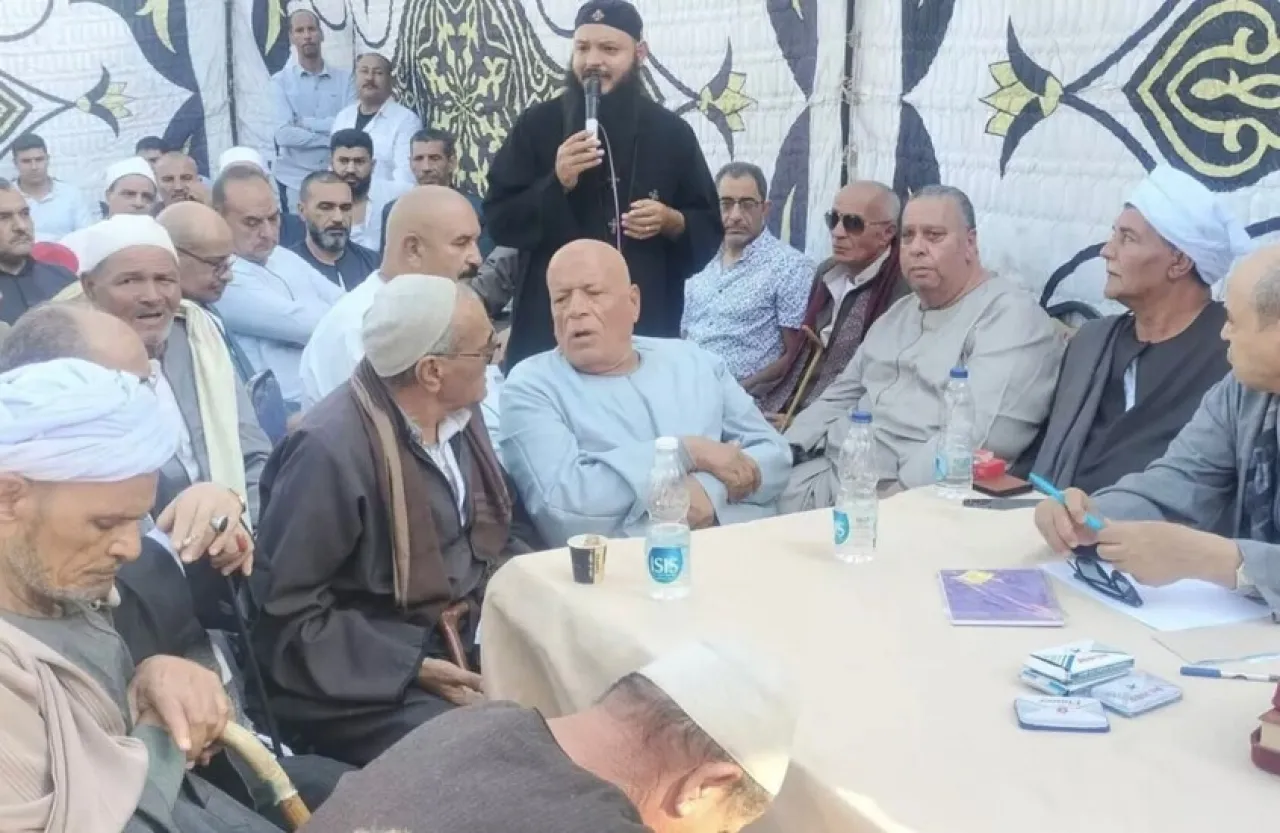
Khaberni - A customary reconciliation session in Bani Mazar, Minya, in Upper Egypt sparked a wide national crisis after it resulted in the forced displacement of an entire Christian family and imposed a financial penalty reaching one million Egyptian pounds.
The reconciliation session, which took place on Friday attended by hundreds of locals under the sponsorship of the mayor as a government official, turned into a collective punishment due to a romantic dispute between a Christian young man and a Muslim girl. This forced the family to sell their homes and leave the village within five years, sparking parliamentary and legal outrage accusing all involved of "igniting sectarian strife under the guise of tradition."
The situation began with a romantic relationship between an 18-year-old Christian young man and a 16-year-old girl from a Muslim family, where the young man went to buy groceries from her family's shop, and she fainted for unknown reasons. He then took her to his home to help her before returning her to her family.
According to eyewitnesses from Al-Jalf village in Bani Mazar where the incident occurred, the girl's family quickly accused the young man of kidnapping her, leading to limited assaults on Coptic homes and properties, and several individuals, including the young man, were arrested.
However, matters escalated to a customary session that immediately decreed the young man's displacement and gave his family five years to leave, along with a one-million-pound fine as compensation, according to statements from two customary arbitrators.
Dr. Freddy El Beiyadi, a member of the House of Representatives and Vice President of the Egyptian Democratic Social Party, submitted an urgent inquiry request to the Prime Minister and the Ministers of Interior, Justice, and Local Development. He described the session as "unconstitutional," highlighting that the family was coerced under fear and intimidation, without waiting for the public prosecutor’s investigations.
The Egyptian parliamentarian and politician stated that "these are collective decisions outside the legal framework, and they encourage sectarian discrimination and threaten social cohesion," demanding that the security services investigate the instigators, compensate the affected individuals, and study the causes of such incidents recurring in Minya, as well as discuss a draft law for an Anti-Discrimination Commission.
El Beiyadi also warned against government officials participating in such sessions, seeing it as a "conspiracy with customs at the expense of the law."
Meanwhile, the Egyptian human rights activist and a member of the National Dialogue's board of trustees demanded that the public prosecutor immediately investigate the incident after the Christians in the village were subjected to assaults on their persons and properties.
El Baradei confirmed in a post on his Facebook account that what happened "constitutes crimes punishable by the Egyptian Penal Code, undermines justice, and places the administration of justice in the hands of individuals who control the fates of each other."
The renowned human rights activist added that "allowing individuals to set up their own courts and issue and execute judgments without being empowered to do so must not be overlooked."