Khaberni - As the challenges of climate change in Jordan increase, from rising temperatures and declining rainfall rates to worsening water shortages, agricultural innovation emerges as a first line of defense to ensure the sustainability of production and improve the livelihoods of farmers in villages and rural areas.
Among the prominent models that embody this approach are 16 field schools implemented by agricultural guides from the Ministry of Agriculture within the project to build capacity to adapt to climate change in Jordan through improving water use efficiency in the agricultural sector (BRCCJ), which is implemented by the Food and Agriculture Organization of the United Nations (FAO) through: Ministries of Water and Irrigation, Agriculture and Environment, and the United Nations Development Programme, funded by the Green Climate Fund (GCF) in the provinces of the Dead Sea Basin: Madaba, Karak, Tafilah, and Ma'an.
These field schools operate as practical educational models, allowing farmers to test modern agricultural techniques that are compatible with climate changes, and help manage water resources with higher efficiency, achieving sustainable productivity.
Empowering Agricultural Staff
As part of the project on building the capacity to adapt to climate change in Jordan through improving water use efficiency in the agriculture sector (BRCCJ), 53 male and female engineers from the agricultural extension staff last year were trained intensively over 3 months, from the provinces of Madaba, Karak, Tafilah, and Ma'an to become trainers and facilitators for climate-smart field schools for farmers.
These schools aim to develop the participants' skills in transferring agricultural knowledge and applying innovative environmental solutions in reality, with a focus on community involvement, especially rural women.
Agriculture at the Heart of Homes: The "Jabunat" School in Madaba
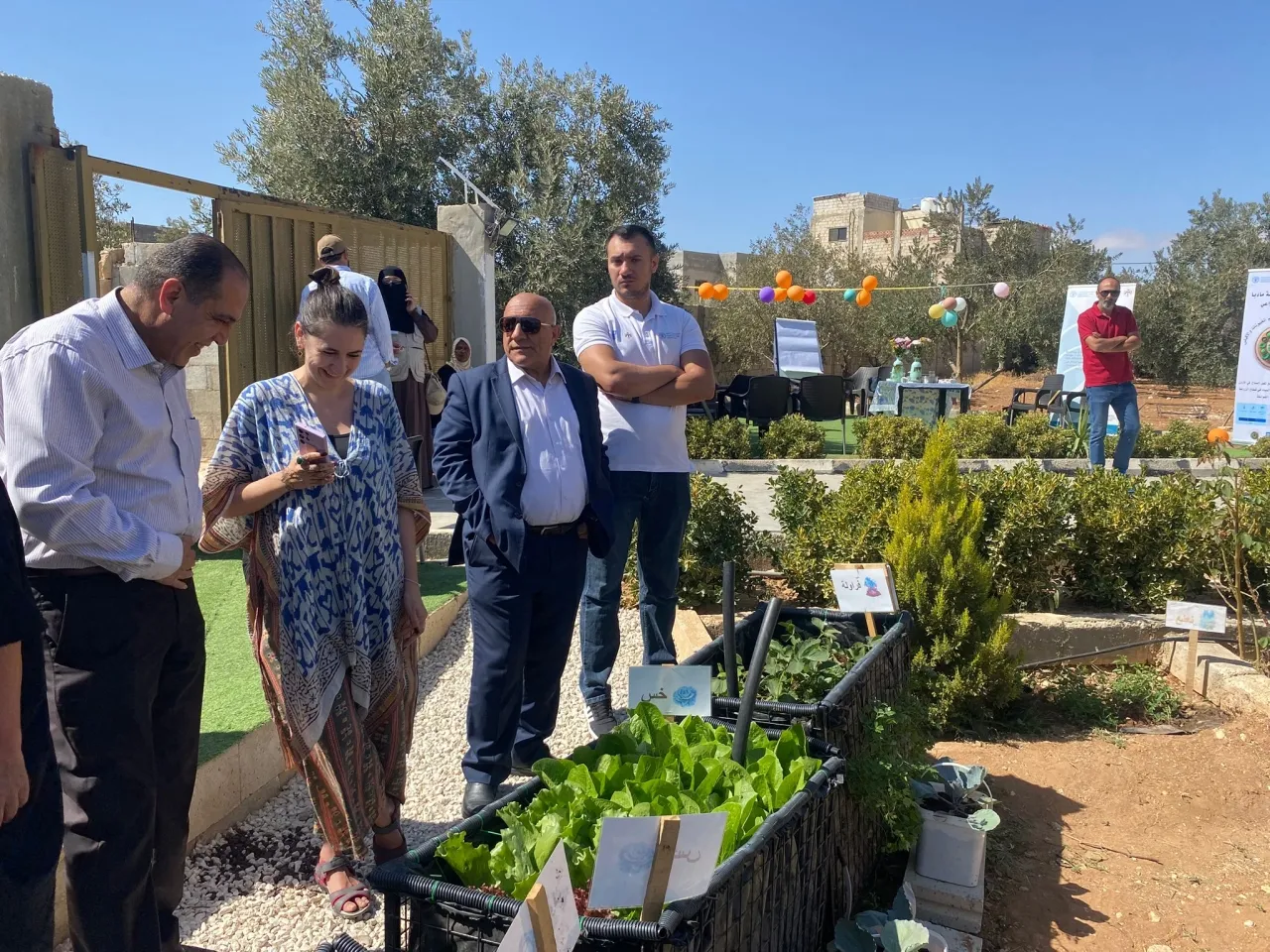
In Madaba, specifically in the eastern Al-Mamunia area, engineer Nawal Al-Shawabkeh from the Agricultural Extension Department implemented a home field school applying the economical Jabunat technique, a modern agricultural technique proven efficient in small gardens and limited spaces.
Engineer Al-Shawabkeh says, "The Jabunat technique has proven remarkably successful in trial and error in plant growth and water conservation, enabling us to double production and utilize every square meter, while significantly reducing the amounts of irrigation water."
Fifteen female farmers from the area participated in the school, exchanging expertise about cultivating leafy vegetables and strawberries within simple home spaces.
Um Yousef, one of the participants in the school, narrates: "The Jabunat technique turned the tight spaces in our homes into fruitful green corners, allowing us to produce parsley, strawberries, and lettuce with less water, and even opened up a small additional income source for us."
Saving the Ancestral Orchards: The "Sharnouqa" School in Karak
In the village of Jowzah in the Karak county, parched land witnessed a pioneering experiment with the Sharnouqa technique, carried out by engineer Ramzi Al-Dmour within the framework of the climate-smart field schools.
Al-Dmour says: "The area was known for its water springs, most of which dried up in recent years. The Sharnouqa experiment came to save the old orchards with a technique that saves water and maintains soil moisture for long periods."
The school planted 60 trees of lemons and guavas, half with the Sharnouqa technique and half with drip irrigation.
Within just 45 days, the results were clear: the trees planted with the Sharnouqa technique consumed only 2.5 cubic meters of water, compared to 20 cubic meters with traditional irrigation, with twice as long vegetative growth recorded.
"The Sharnouqa technique saved over 80% of the irrigation water and preserved the trees without loss. It is a realistic solution to the water shortage problem threatening the sustainability of agriculture in our areas," adds Al-Dmour.
Al-Habees Dam… A New Life Source for Agricultural Lands
While water resources are diminishing in Karak province, the establishment of Al-Habees Dam is a significant step towards revitalizing agricultural lands and supporting the efforts of field schools in enhancing water and agricultural security.
A farmer participating in the field schools in Jowzah says: "We need to establish a dam at the bottom of the valley to collect rainwater and floods and harness them to recharge groundwater and irrigate adjacent lands, which allows us to reclaim areas that have been abandoned for years due to drought."
He adds: "Establishing Al-Habees Dam not only provides us with water, but it also brings life back to the land. With the application of advanced techniques we learned in field schools, our ability to conserve water and increase production will be greater."
From Fodder to Sustainability: The "Azolla" School in the Southern Ghor
In Al-Safi Ghor, engineers Adnan Al-Muradat and Ghalib Khreisat from the Directorate of Agriculture in the Southern Ghor implemented a field school for the Azolla technique, a protein-rich plant that can be used as poultry feed and forms a plant cover that reduces evaporation.
Muradat explains: "We chose the Azolla technique because it provides a natural alternative to costly feeds, as well as helping in water conservation. Farmers in the area are raising fish, providing a good environment for cultivating Azolla, and this integration between aquaculture and agriculture has created a closed ecological system that reduces waste and increases sustainability, making the experiment a model to be emulated in dry regions."
Field Schools… Laboratories for Knowledge and Change
From Al-Mamunia to Jowzah to Al-Safi Ghor, field schools represent more than just training initiatives, but platforms for participatory learning, where farmers become partners in developing solutions, not just recipients of them.
As Jordan continues its efforts to combat the effects of climate change, these experiments stand as a testament that investing in agricultural knowledge is the path towards a greener and more sustainable future.