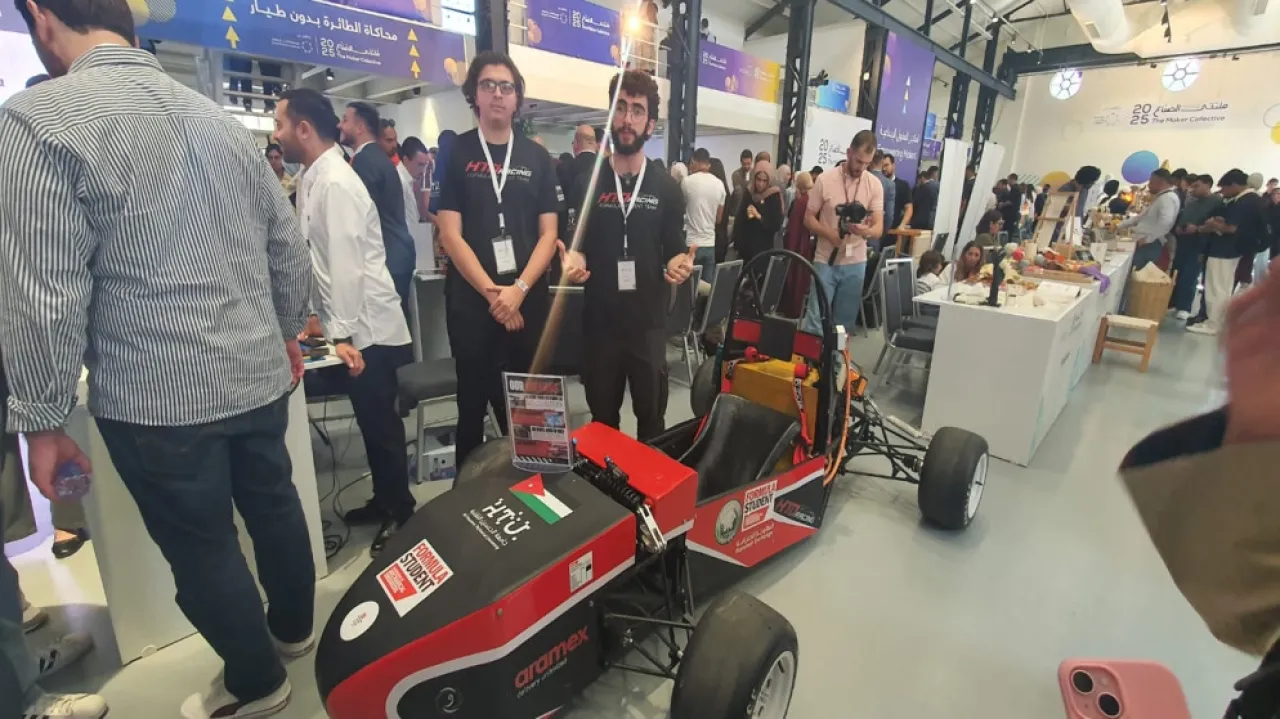
Khaberni - In a race against time and its accelerated developments, students from Al-Hussein Technical University succeeded in manufacturing a fully electric Formula Student (Formula Student) car, amid continuous efforts from them to transform it into a self-driving vehicle at speeds suitable for racing.
In a limited space not exceeding the size of the vehicle during the Industrial Gathering, held in its second edition on Saturday organized by the Crown Prince Foundation, students from Al-Hussein Technical University, driven by creativity, showcased their innovation which reached the United Kingdom and became a reality on the ground, as the Formula car became a moving reality, not just slogans or intentions for work.
The students involved in the invention of the vehicle say in their discussion on the sidelines of the gathering that the vehicle was launched in April 2025 and actually traveled in Jordan, in addition to being showcased in the United Kingdom in past July during the participation in the Formula Student UK race, according to Al Mamlaka TV.
The vehicle, which is entirely a Jordanian invention, can travel at a speed of up to 120 km/h, and it can go from zero to one hundred in just five seconds, and without using fuel, as it is entirely electric-powered.
In the city, the car covers a distance ranging between 50 and 60 km on a single small battery charge.
The Jordanian invention came to light after patience, hardship, and repeated attempts; it was not a matter of pushing a button as some might think, but through continuous effort that lasted about three and a half years, and accumulated experiences from one student to another. The invention is still under development to keep up with self-driving technology, which will enable the vehicle to read the road after completing its smart system, reaching the stage of full self-driving.
Regarding the presence of ideas for development and transition to inventing conventional electric vehicles, the students say that they started with an idea aimed at displaying their creativity on a global and regional level, hence the start with a racing vehicle and not a conventional vehicle common across the world.
The cost of manufacturing a single vehicle is around 35 – 40 thousand dinars.
The Hussein Technical University Racing Team (HTU Racing) is the first team from Jordan and the Middle East to design and manufacture a Formula Student (Formula Student) car.
The team includes more than 80 male and female students from Hussein Technical University, who worked diligently to design and manufacture the car, confirming the Jordanian youth's ability to compete globally.
It should be noted that the Crown Prince Foundation concluded on Saturday the activities of the second edition of the "Industrial Gathering" at the Hussein Cultural Center and Hangar Ras Al-Ain in the capital Amman, as part of the activities of the "Industrial Space" program, one of the foundation's programs.
The gathering, which attracted more than 4,200 visitors from all governorates of the Kingdom, aimed to unite and empower the community of industrialists, innovators, and supporting institutions in this sector in various categories, from students, researchers, hobbyists, entrepreneurs, and designers, within a national platform for exchanging expertise, building partnerships, and stimulating innovation.
The gathering provided visitors with the opportunity to experience digital manufacturing tools throughout the day, such as three-dimensional printers, CNC machines, laser cutters, and closely observe how these technologies are employed in the development of prototypes and innovative products.
The gathering also included the announcement of the "Industrial Map," a national digital platform that is the first of its kind in Jordan, serving as a comprehensive guide linking manufacturing spaces, labs, innovation incubators, universities, and empowerment entities, thus enhancing cooperation between academic institutions, emerging companies, and independent innovators.
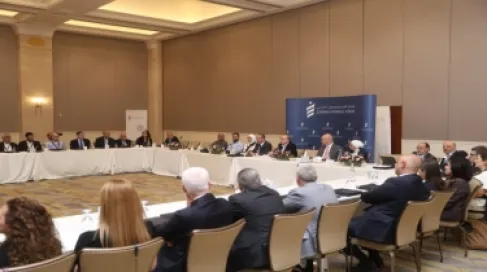
The gathering witnessed a specialized discussion session titled "Empowering the Future of Industrial Communities in Jordan", with the participation of several active parties and supporters of innovation and local industrialists, from incubators and business accelerators, academic institutions, and representatives from the public and private sectors, to exchange knowledge and experiences, showcase local and global experiences, discuss future challenges and opportunities, and provide recommendations to develop the industrial community in Jordan, within the efforts of the institution to enhance cooperation among various parties in this framework.
The gathering also included an exhibition for innovations and tangible products participated by more than 114 exhibitors from students, startups, and designers, in an interactive environment that enhanced the spirit of innovation and exchange of expertise, where the best innovative project at the exhibition was announced based on visitor voting at the end of the gathering.
The gathering showcased experiences and success stories with the participation of several local entrepreneurs and innovators, through a series of discussion and informative sessions covering topics in digital manufacturing, technology, sustainability, localization of engineering expertise in Jordan and the Arab world, investing, building global companies, unmanned aircraft, designing and manufacturing medical solutions, and others, as well as hosting the international speaker Daniel Ingracias, who shared his experience in designing and building open-source manufacturing machines (Open source) and developing advanced innovative tools to support innovators worldwide.
In addition, the gathering included the implementation of 6 practical workshops on various topics such as design and digital manufacturing, the Internet of Things, three-dimensional printing, and provided the opportunity for visitors to meet more than 16 experts, entrepreneurs, and specialists in individual consulting sessions within the "Experts' Corner".
The gathering featured several interactive activities, including the "Elevator Pitch" experience, which allowed over 60 rising entrepreneurial youths from various governorates and age groups to present their ideas and projects within one minute, aiming to encourage creativity, validate innovative ideas, and provide an opportunity for the owners of distinguished ideas to benefit from guidance and continue developing their projects within the institution's programs.