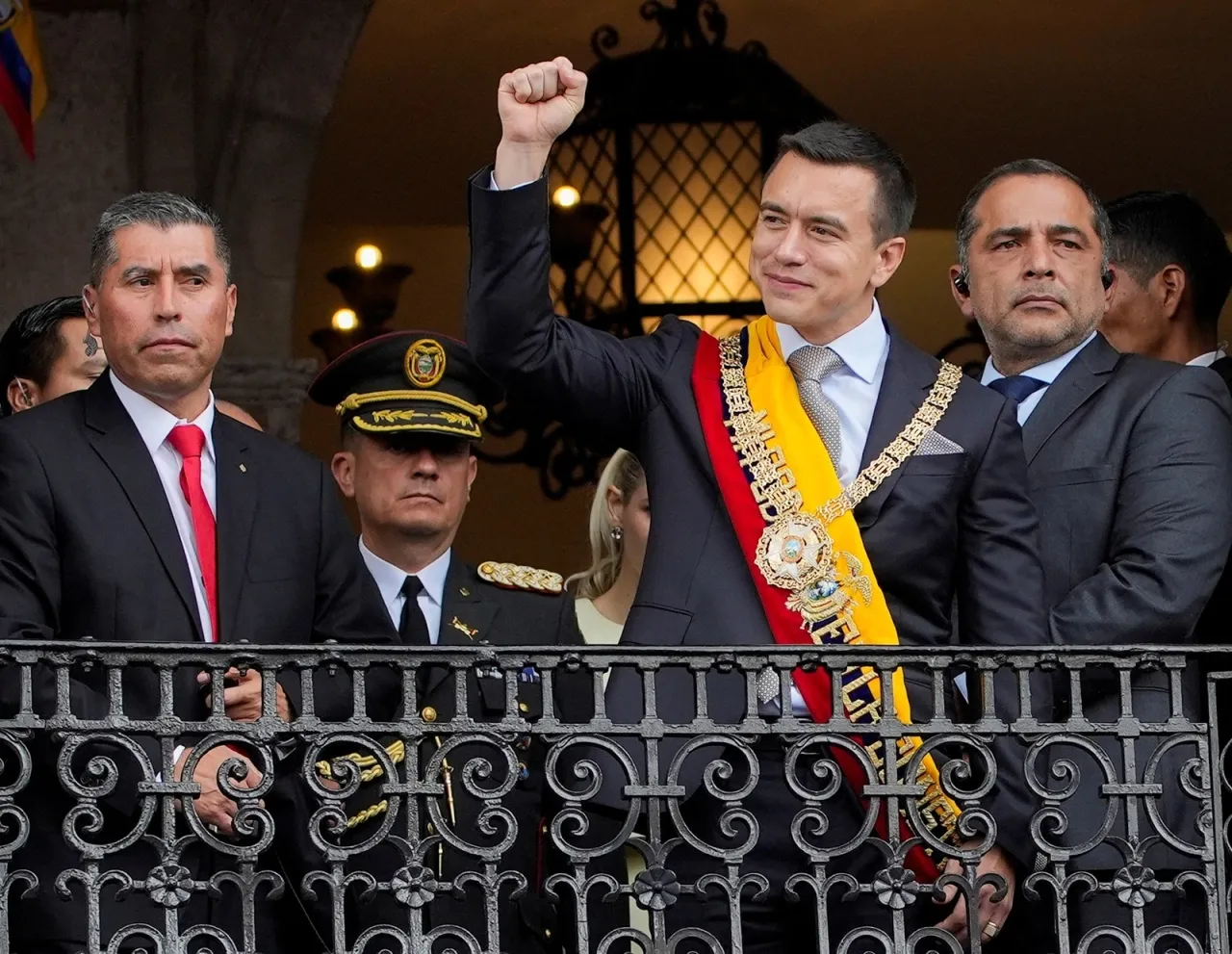
Khaberni - Ecuadorian President Daniel Noboa said that the last month was full of events for him, having survived three alleged assassination attempts, the latest of which included gifts of jam and chocolate mixed with toxic chemicals.
Noboa's statement came during an interview with CNN's Fernando del Rincon on Thursday, where he mentioned that the gifts contained "very high concentrations" of three chemicals, explaining that "it is practically impossible for these substances to be together in these proportions unless they were deliberately added."
These claims come just weeks after another assassination attempt when crowds surrounded Noboa's car as he was traveling to an event in Canar province, hurling stones at it. According to Energy Minister Ines Mansano, traces of bullets were later found in the vehicle, while Noboa said that another crowd had thrown Molotov cocktails and homemade rockets at him days earlier.
Despite skepticism from some critics about the legitimacy of these claims, due to the lack of public evidence, considering them possibly intended to distract from escalating public anger against his government, Noboa insisted in his talk with CNN that the threat was "real."
The president said, "It was not just sticks and stones. There were homemade rockets, Molotov cocktails, and projectiles that could kill you... From above, they threw rocks at the windshield and the hood."
He added, "If one of these homemade rockets hits you in the chest or head, it will kill you."
Nevertheless, one thing is undisputed: the President of Ecuador is not lacking in enemies.
Noboa, 37 years old, heir to the banana empire and one of the wealthiest in Ecuador, won his first full term in office this year after promising to combat drug-trafficking "terrorist gangs" that have turned the country from a peace beacon into having some of the highest murder rates in Latin America.
Since then, Noboa has adopted a strongman approach and a hard-hitting crime policy that made him popular with voters during his first term, making him a target for major criminal gangs.
However, it wasn't just these criminal networks. With murder rates rising again and growing public discontent caused by economic issues such as rising diesel prices, Noboa's popularity has taken a noticeable dip. By February 2024, 81% of Ecuadorians approved of his performance, according to a local Cedatos poll, but this number has now dropped to around 50%.
In a country used to "very unpopular" presidents, as stated by Laura Lizarrizo, senior Ecuador affairs analyst at the political consultancy Control Risks, this is still relatively high support. Yet Noboa faces increasing opposition from indigenous groups and civil society organizations because of his unilateral decisions and attempts to expand executive powers.
Among his most controversial decisions, particularly in rural areas and among indigenous people, was the cancellation of fuel (diesel) subsidies, leading to widespread protests. He also faced criticism for merging the environmental control agency with the Mining Ministry, raising concerns about weakening environmental laws, in addition to his attacks on the judiciary when the court annulled some of his security proceedings, which included granting comprehensive immunity to security forces.
Lizarrizo said, "He has made some politically divisive decisions that have not been popularly welcomed, with one of the most prominent examples being the recent wave of protests over diesel support."
During the protests, Noboa declared a state of emergency in several provinces. The movement subsided after he threatened to send the army to open roads blocked by demonstrators. In the end, the president agreed to reduce the price of diesel in two phases in December and February.
On October 12, the capital Quito witnessed violent clashes between demonstrators and army forces protesting against the increase in diesel prices and other economic measures imposed by the government.
Escalation of Violence
Despite adopting a tough stance on crime, the signs of failure of this approach began to appear. After a brief calm last year, murder crimes increased by 40% during the first seven months of 2025. Last week, car bomb explosions shook the city of Guayaquil, killing one person, while September witnessed two consecutive massacres inside prisons.
Despite the deployment of the army in prisons and the streets and the arrest of the country's most wanted during the summer, all this comes.
In his discussion with CNN, Noboa acknowledged the rise in murder rates, but he emphasized that the majority of them happen among criminals themselves. He said, "The numbers are similar to 2023. The difference is that in 2023, 6 out of 10 of the dead had a criminal record, today, 9 out of 10 have histories. They are killing each other."
Some critics doubt that Noboa's strict policy will only worsen the situation.
Political analyst in Quito, John Paul Pinto said, "Noboa believes that using the army is the best way to fight drug trafficking, but what we see here in Ecuador proves that this is a very bad strategy, it does not work."
Pinto added, "Security is not just about the army, police, or intelligence, but also about solving economic and social problems and involving the private sector."
Relations with Trump
Among Noboa's most controversial policies, a plan to amend the Constitution to allow the stationing of foreign forces at Ecuadorian military bases, a step set to be presented in a public referendum next month.
It seems that Noboa is confident that the voters will support him, as his government has already started plans to establish a U.S. naval base on the Ecuadorian coast.
Meanwhile, Noboa sought to get closer to U.S. President Donald Trump, where he posted on social media this week, praising Trump and confirming that "Ecuador stands firmly in the global war against drug trafficking," while other countries in the region have expressed concerns about U.S. strikes against alleged drug traffickers in the Caribbean and the Pacific.
Noboa told CNN that he supports the fight against drug trafficking, "which affects society as a whole," adding that his country has already formally requested joint operations with U.S. forces.
According to analyst Lizarrizo, the recent wave of violence will not push Noboa to change his security strategy, but rather the opposite: "For his government, these events are not proof of the failure of the security policy, but rather a justification for taking stricter measures against organized criminal groups. This is a fundamental part of the government's security discourse and the image of a strong man and tough policies."
Figure of Strength
Analysts say that Noboa's personal image has always been the center of his political strength. He is young, proficient in social media, and skilled in the politics of showmanship and symbolism.
Lizarrizo said, "He is an unconventional leader for Ecuador, relying on his image and rhetoric more than relying on a comprehensive, evidence-based policy to face the multiple crises that the country is going through."
Pinto referred to Noboa's clash with the Constitutional Court earlier this year regarding his security policies. After the court suspended several of his measures, including granting immunity to the security forces, Noboa personally led a march in the streets of Quito in protest.
During the march, huge panels displaying images of the nine judges were set up accompanied by a phrase in red: "These are the judges who are stealing our peace."
The next day, Noboa told a crowd of supporters, "We will not allow nine people who do not even show their faces to stop the change."
Critics warn that this move could endanger the judges, but it was not the first time Noboa had defied constitutional and institutional norms.
Lizarrizo said Noboa caused a diplomatic crisis in April 2024 when he ordered security forces to storm the Mexican embassy to arrest a former vice president wanted for corruption charges who had sought political asylum there.
She added, "He has clear authoritarian traits and behaviors that are likely to continue throughout his tenure. He will continue to test the limits of executive power and seek to expand his powers to implement his tough security agenda."
Regarding the upcoming constitutional referendum, Lizarrizo said it was a "divisive question," but she clarified that Noboa possesses the state tools and the media on his side.
In the interview, Noboa stated that he would accept the referendum results whatever they may be, but he expressed his confidence that people would stand by him, adding, "I am convinced that people want real change."