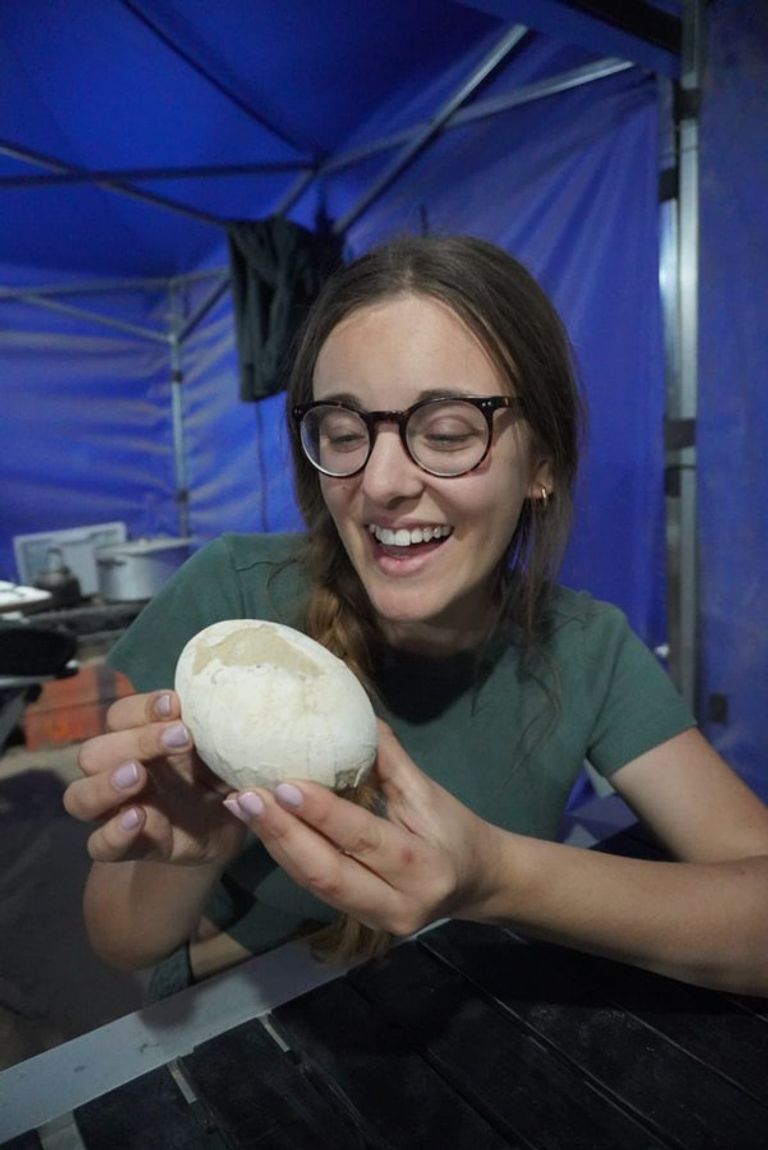
A team of researchers in the Patagonia region of southern Argentina has found a rare dinosaur egg dating back about 70 million years, preserved in an exceptional condition that makes it appear as if it was just laid.
The egg was discovered in the Rio Negro area, and its shape resembles that of an ostrich egg, but preliminary analyses confirmed that it belongs to a small carnivorous dinosaur of the "Bonapartenykus" species, which lived during the late Cretaceous period.
Researcher Gonzalo Muñoz from the Bernardo Rivadavia Museum of Natural Sciences explained that finding an egg preserved in such a condition is a rare event, especially since carnivorous dinosaur eggs are fewer than those of herbivorous species, and their thin shells make them more susceptible to damage over time.
The research team hopes that the egg contains embryonic tissues, as it is being prepared for radiographic examinations at the museum as part of a comprehensive study involving other discoveries from the same site. If embryonic remains are confirmed, this discovery will be one of the most significant achievements in South American paleontology, offering new insights into dinosaur evolution and their reproductive nature.
This discovery is part of the "First Cretaceous Expedition" project, which previously uncovered mammalian teeth and snake vertebrae at the same site, indicating that the area was a natural habitat for dinosaur nesting tens of millions of years ago.
A video clip showed the moment when team leader Federico Aniolin discovered the egg on the ground surface, his face expressing shock and amazement at its rare preservation state. Nearby, a broken egg was also found, suggesting that the site was a complete nesting colony for those ancient creatures.