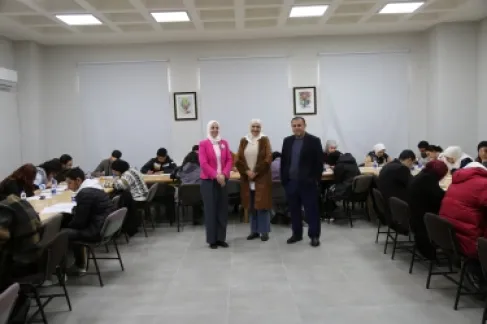
Khaberni - As part of the university's strategic orientations towards enhancing the quality of the educational process and achieving international accreditation standards, the Faculty of Architecture and Design at Al-Ahliyya Amman University launched a series of specialized academic workshops, which extended over three recent days, with the participation of faculty members and laboratory supervisors at the college.
These workshops aim to develop and standardize course plan models in accordance with the Jordanian National Qualifications Framework (NQF) and local and international accreditation standards. The newly introduced models include the Student Syllabus, the Instructor Syllabus, and the Instructor Reference Guide, which are designed to be comprehensive tools that ensure clarity of educational outcomes and their systematic measurement, and support the implementation of automation and institutional analysis processes across all academic programs.
These workshops are part of the faculty's plan to activate Outcome-Based Education and link it directly with measurement, evaluation, and assessment processes, reflecting the faculty’s commitment to embedding a culture of sustainable academic quality and developing an educational environment based on creativity, academic responsibility, and adherence to global standards in applied and design education.
In her opening speech, the Dean of the Faculty of Architecture and Design, Professor Dr. Rama Al-Rabadi, emphasized that this step is a fundamental axis in the comprehensive academic, administrative, and logistical development plan of the faculty, noting that unifying academic models and developing teaching and learning methods within departments are part of an ongoing institutional process aimed at enhancing the quality of education, research, and creative training, thus enhancing the college’s local and international stature.
The workshops were presented by the Deputy Dean for Accreditation and Quality Affairs, Dr. Hanan Al-Sheikh, who reviewed the new academic models analytically and applicatively, and clarified the mechanisms for linking learning outcomes (CLOs) and program outcomes (PLOs) with level specifications in the national framework and sustainable development goals (SDGs).
She detailed the assessment mechanisms, modern teaching and learning methods, and how to document academic processes to ensure integration in the institutional measurement system at the college level.
This initiative is part of the faculty's vision to build a modern and integrated educational system that balances academic authenticity and digital innovation, and contributes to preparing graduates with high capacities for critical and creative thinking, capable of keeping up with regional and international labor market transformations in the fields of architecture, design, and applied arts.