Khaberni - Marouf Al-Rifai, advisor to the Governor of Jerusalem, considered the Israeli Knesset's "preliminary reading" vote on two bills for the complete annexation of the West Bank and the imposition of Israeli sovereignty over the Ma'ale Adumim settlement as a dangerous indicator of Israel's progress in implementing the annexation plan, whether in the West Bank or occupied Jerusalem.
The General Assembly of the Israeli Knesset, at the "preliminary reading," approved two bills for the complete annexation of the West Bank and the imposition of Israeli sovereignty over Ma'ale Adumim settlement; it was then referred to the Foreign Affairs and Security Committee to complete its legislative deliberations.
Al-Rifai said that the "Ma'ale Adumim" settlement, established in 1977, is located on lands from the West Bank occupied in 1967, and according to the Oslo Accords, it was supposed to be that the fate of the settlements built on the 1967 borders was within the final negotiations of the solution, as they are settlements on the West Bank, where their existence violates international legitimacy decisions, including resolution 2334 which considers settlement in the West Bank and East Jerusalem illegal and calls for its removal.
He added that the "E1" project announced by the occupation government, which involves the construction of 3412 new settlement units to expand the "Ma'ale Adumim" settlement, comes in the context of imposing realities on the ground and connecting the settlement to East Jerusalem in preparation for its official annexation.
He explained that the "E1" project aims to connect the "Ma'ale Adumim" settlement to East Jerusalem, and isolate it from the towns of Al-Eizariya, Abu Dis, and Al-Tur, representing a step towards imposing a new settlement reality on the east of the city. The project covers an area of about 12,000 dunams including lands from the towns of Al-Issawiya, Al-Tur, Anata, Al-Eizariya, and Abu Dis, within the "Greater Jerusalem" plan, aiming to prevent any expansion of Palestinian neighborhoods and connecting the settlement blocks east of Jerusalem.
He pointed out that the extreme Israeli National Security Minister Itamar Ben-Gvir and the extreme Israeli Finance Minister Bezalel Smotrich condition their continued support for the government on the clear implementation of the annexation plan, both in Jerusalem and in the West Bank, as clearly seen in this recent vote in the Knesset, although it has not yet become a final law.
He mentioned that the occupation authorities informed the residents of the Qalandiya area, north of Jerusalem, of their intention to confiscate 350 dunams of their land located in the Atarot industrial area for its expansion at the expense of private Palestinian lands, clarifying that the targeted lands are privately owned by the people of the area.
Al-Rifai confirmed that 100 dunams of these lands are outside the racist separation wall, and 250 dunams of it are inside the wall, but they are private properties owned by individuals and documented in the Jordanian, Ottoman, and English Tabu (land registry), which is part of the "Greater Jerusalem" project aimed at controlling vast areas extending to Jericho eastward and Bethlehem southward, within a systematic plan to isolate Jerusalem from its Palestinian surroundings.
Al-Rifai stressed that these steps represent a blatant violation of international law and occur amidst a mysterious international silence, demanding that the international community take responsibility for what the Palestinian people are subjected to in terms of displacement, annexation, and settlement policies.
One of the Largest Settlements
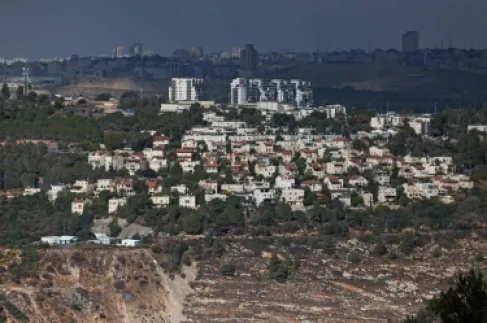
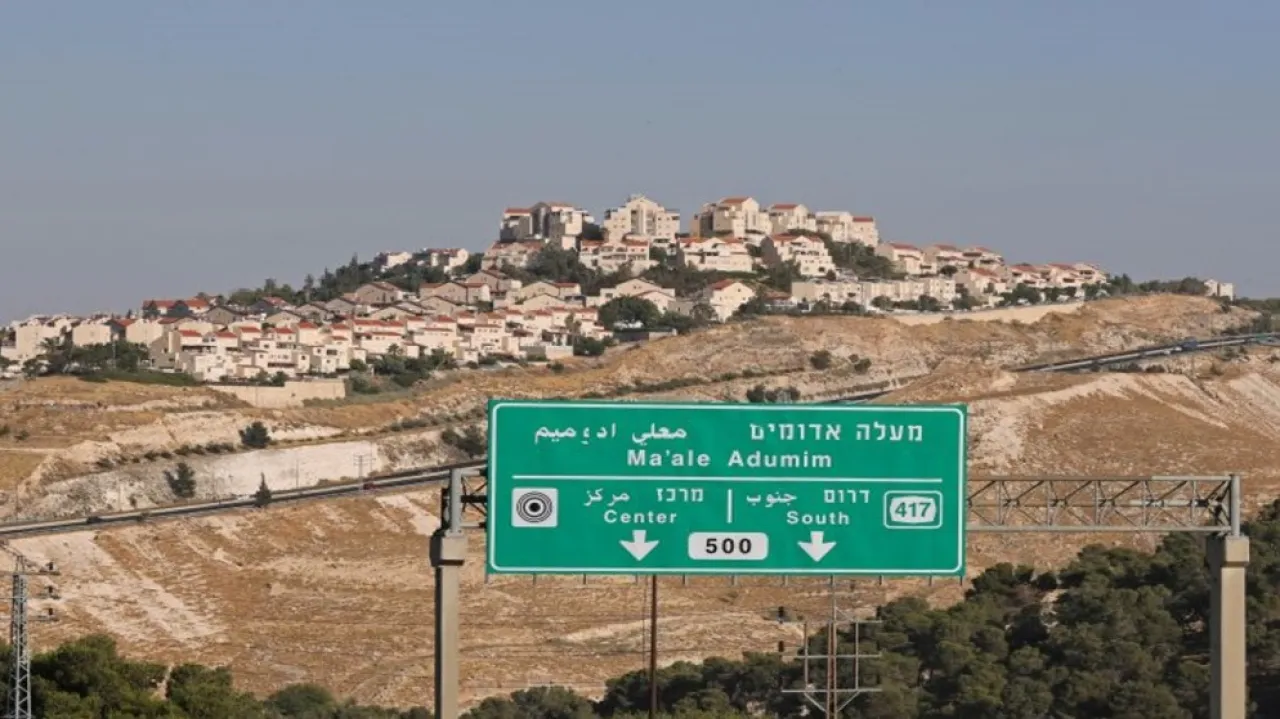
"Ma'ale Adumim" settlement is one of the largest settlements in the West Bank, built on large parts of the lands of the Palestinian towns of Al-Eizariya and Abu Dis, 7 kilometers east of Jerusalem.
The settlement is located in the West Bank and extends along the historic road linking the occupied city of Jerusalem and the city of Jericho, 7 kilometers east of Jerusalem, where it spans more than 48,000 dunams.
It is home to more than 40,000 settlers and is surrounded from the west towards Jerusalem by the towns of Al-Eizariya, Abu Dis, and Al-Issawiya, from which large areas were confiscated for the benefit of Ma'ale Adumim.
The initial idea for establishing the "Ma'ale Adumim" settlement was a proposal that aimed to build a settlement to separate Jerusalem from its Palestinian surroundings and control the vital road between occupied Jerusalem and Jericho and connect them to the Dead Sea and the Jordan Valley.
In 2008, the occupation government continued to expand the settlement and approved the construction of hundreds of new residential units in "Ma'ale Adumim," as part of the "E1" settlement project aimed at expanding the settlement and connecting it to Jerusalem and isolating its north from its south.
In March 2017, Israel issued 42 demolition orders for buildings in the Khan al-Ahmar area located in the "E1" area, and in the summer of 2025, the Israeli Finance Minister Bezalel Smotrich approved the financing of that old settlement plan to expand the Ma'ale Adumim settlement by more than 3400 new housing units.