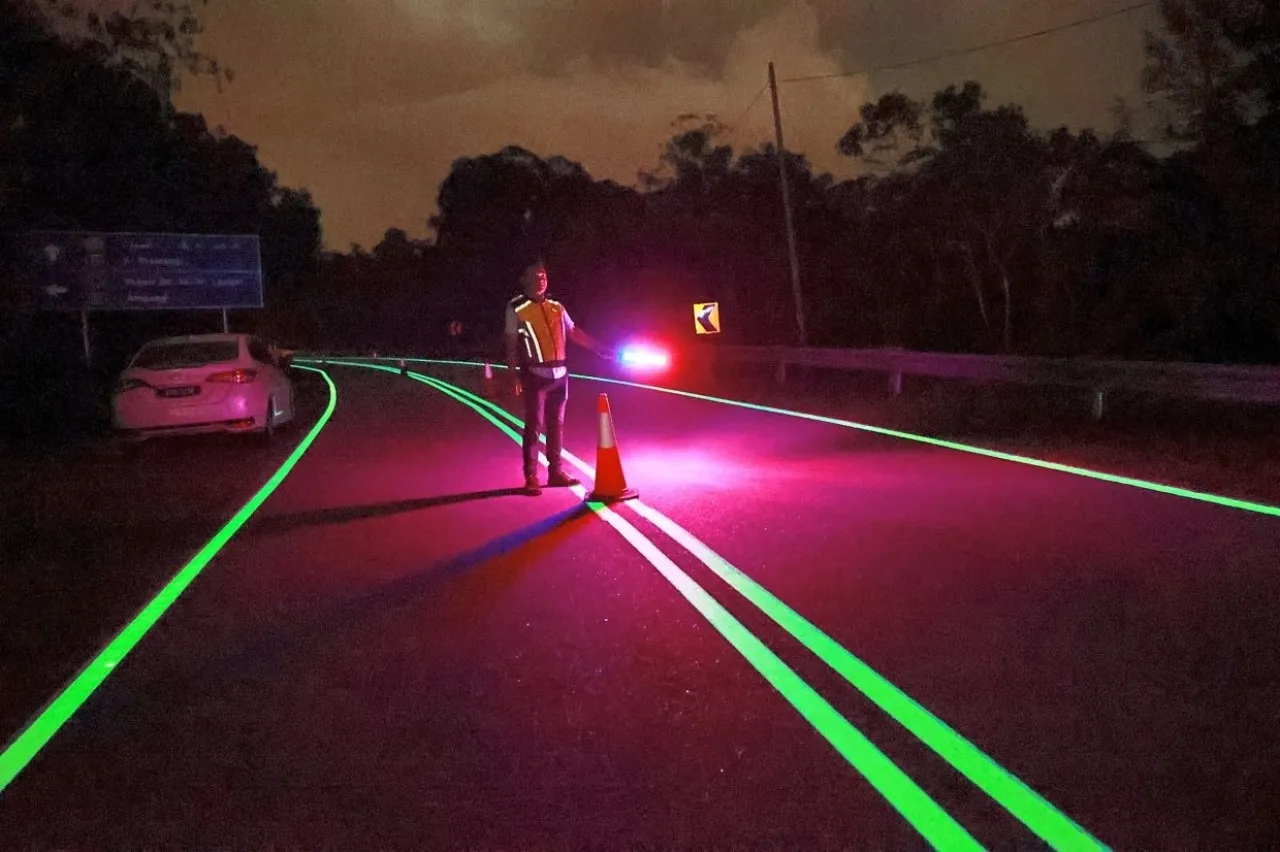
Khaberni - The state of New South Wales in Australia is preparing to expand the use of what is known as "glowing roads" after a 6-month field trial proved successful in significantly reducing night-time accidents.
The state's Transport Authority said on Tuesday that the test, conducted on a 200-meter stretch of the notoriously dangerous Bulli Pass road, showed a 67% reduction in near accidents at night, a result described as "a qualitative leap in road safety."
How do "glowing roads" work?
The concept of the glowing road relies on painting road markings and ground lines with photoluminescent materials that absorb sunlight during the day and store it, emitting a soft glow during nighttime hours without the need for electric lighting.
According to the authority, this technology is suitable not only for highways but also for bike paths, pedestrian paths, airport runways, and car parks, and any environments characterized by poor lighting or rugged terrain.
Bulli Pass road, located about 75 kilometers southeast of Sydney, was chosen as the testing site due to its steep decline and tight turns, making it one of the most dangerous mountain roads in the state.
Official data showed that 125 near-accidents were recorded over 12 months up to 30 June 2024, with 10% of them occurring during late-night hours, double the rate recorded on other regional roads.
The transport authority says the glowing paint made the road markings more visible to drivers in the dark and in adverse weather conditions, helping to improve perception of curves and distances and reduce driving errors.
Comprehensive Policy
In light of the "encouraging" results, the state government is currently considering expanding the trial to include additional stretches in rural and coastal areas, focusing on roads that experience high accident rates or have poor public lighting.
The state's traffic safety director says this initiative is part of New South Wales' plan to cut road deaths in half by 2030, pointing out that "low-cost smart technologies like glowing roads demonstrate that safety can be achieved through creativity and not just by spending."
International Trials
New South Wales' trial is not the first of its kind. In 2022, the state of Victoria conducted a similar trial, but later halted it after concluding that the safety benefits did not justify the operational costs.
In the Netherlands, experiments began a full decade earlier but encountered an unexpected setback: the glow diminished after the paint became wet, leading authorities to halt the project after a short period.
Despite these setbacks, transportation experts believe that advancements in photoluminescent material technology have made it more efficient and sustainable today, especially in sunny countries like Australia, where the stored light energy can last up to 10 continuous hours.
Safer Roads
Analysts indicate that glowing roads represent a rare blend of environmental and functional innovation, as they reduce the need for light poles and energy consumption while enhancing traffic safety, especially in remote areas.
Transport expert Adam Green from the University of Technology Sydney states, "The beauty of this idea is that it combines simplicity and intelligence. Instead of adding light, we made the road itself illuminate."