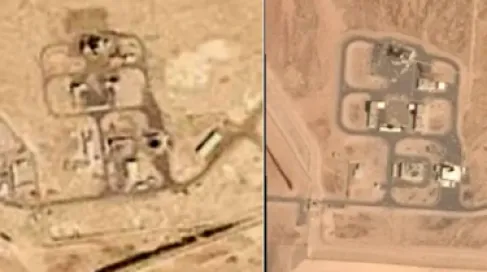
Khaberni - Egyptian water resource expert Abbas Sharaki revealed that all turbines of the Ethiopian Renaissance Dam have stopped working during this period, which led Ethiopia to open the gates of the dam's upper spillway.
The Professor of Geology and Water Resources at Cairo University confirmed that opening one of the gates of the dam's upper spillway, with a discharge of about 200 million cubic meters daily, is nearly equal to the daily rainfall income in this time of October, which is conclusive evidence of the stoppage of all turbines.
Sharaki explained in a post on his official Facebook account that the satellite images analyzed on October 20 confirm the continued complete stoppage of the turbines, noting that the daily rainfall income at the Renaissance Dam will see a gradual decline to 150 million cubic meters by the end of this month, and then 50 million cubic meters by the end of next November.
He added that keeping one gate of the upper spillway's six open is sufficient to pass the current daily water income from the rains, while preserving the full reservoir storage in case the turbines continue to stop. However, if four turbines operate moderately, the spillway gate will be closed.
Doctor Abbas Sharaki confirmed that the High Dam is receiving the water income with high efficiency as usual, and the storage is occurring normally and the Toshka spillway is still closed until October 19.
The Ethiopian Renaissance Dam, which was completed and officially opened this year on the Blue Nile, is one of the Nile's main sources and the largest hydraulic project in Africa with a cost of 5 billion US dollars, aimed at generating 5,150 megawatts of electricity for Ethiopia, covering 40% of its energy needs.
The dam includes 13 turbines, with a storage lake capacity of 74 billion cubic meters, and its reservoir has been filled five times until September 2024, reaching a level of 638 meters above sea level.
Nevertheless, the dam has sparked severe disputes with Egypt and Sudan, which depend on the Nile for 97% and 55% of their water respectively. Egypt, which has historically received 55.5 billion cubic meters annually under the 1929 and 1959 agreements, fears that the dam will reduce the water flow, threatening agriculture (which consumes 80% of the water) and the water security of 100 million people.
Sudan sees benefits in the dam for irrigation and electricity, but fears uncoordinated floods, as occurred in October 2025 when opening the gates led to flooding areas in Roseires, prompting Ethiopia to reduce the discharge to 300 million cubic meters daily to avoid disaster.