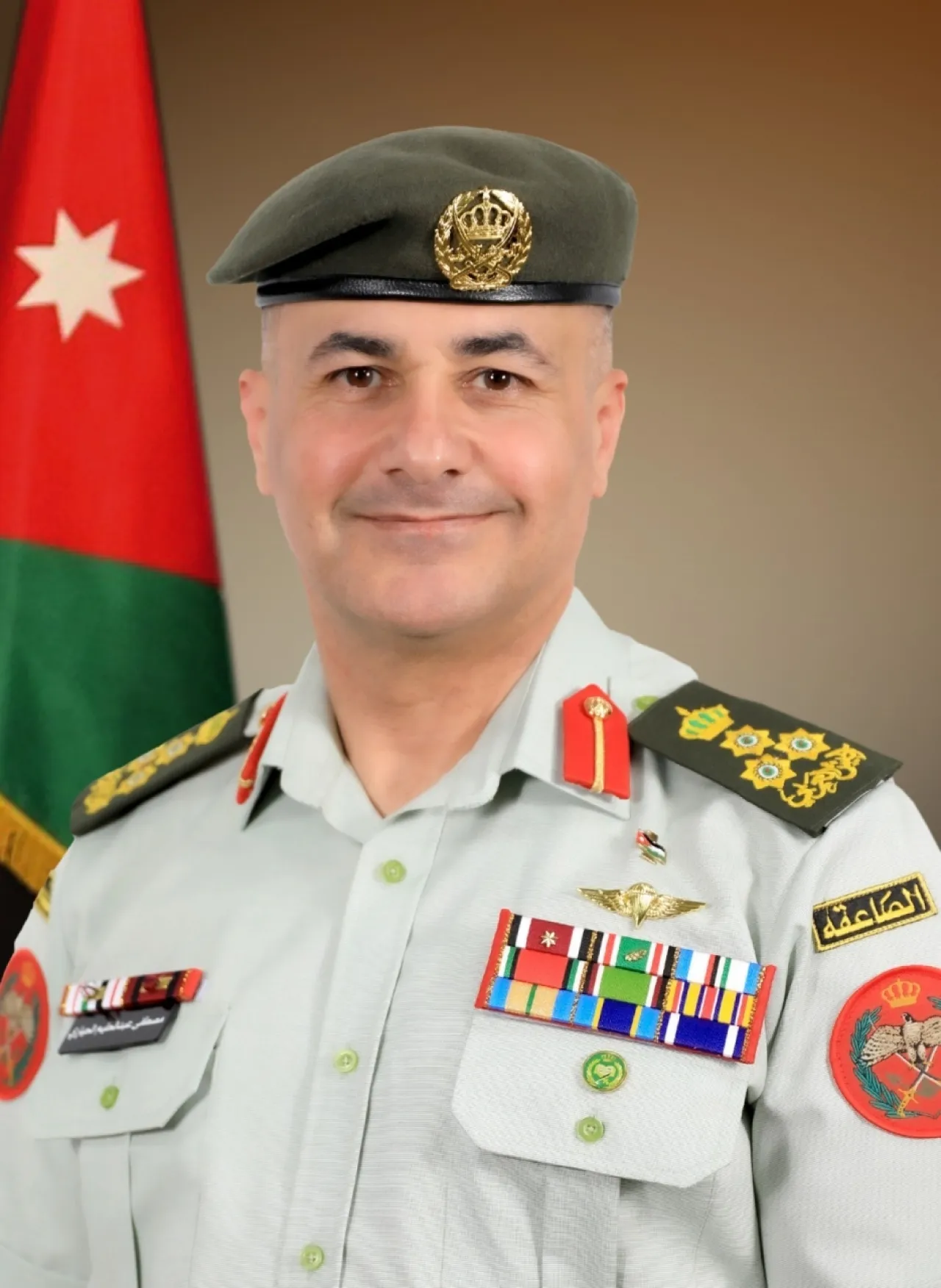
Khaberni - Military Media Director Brigadier General Mustafa Al-Hayari
The participation of the Jordanian Arab Army in the October 1973 War was an extension of a deep-rooted national message that began with the Great Arab Revolt, passed through the battles of Jerusalem and the immortal Battle of Karameh, and reached this battle where the Jordanian Army was positioned on its western borders to form an impregnable barrier protecting the nation's borders, monitoring everything happening on the Syrian and Egyptian fronts, raising the readiness of its units and formations to open a third front on its western borders, and came to open the western front according to Arab agreements and plans if needed. However, the developments in the Golan, and the approaching arrival of the Israeli army in Damascus, urged the Jordanian Army to adjust its agreed plans and move its forces far to the Golan, a location it was unaccustomed to fighting in, answering the call of Arabism.
To aid brotherly Syria, in defense of Damascus, the Royal Armored Brigade/40 moved under the command of the late King Hussein bin Talal at 1730 on October 11 towards Syrian territory. King Hussein stood before his soldiers bidding them farewell at the borders near Daraa, saying, "You are going to support your land… the land of Arabism." The battalions of the brigade were distributed as follows: The Second Royal Tank Battalion towards Da'el, the Fourth Royal Tank Battalion towards Muzayrib and Yadudeh, and the Prince Abdullah I Royal Mechanized Battalion towards Na'eimeh in Syria. At dawn on the fourteenth of October, the Jordanian command took over its combat duties, which involved repelling enemy attacks in cooperation with the Syrian and Iraqi forces, forming a second rank for the Syrian Division/5, and executing a counterattack on the axis of Hara – Mashara – Jabata.
On October 16, the Armored Brigade/40 advanced under the command of Brigadier General Khaled Hijahij, but the right wing of the brigade was exposed due to the sudden retreat of the Syrian forces and delay of the Iraqi forces’ advance, causing the Prince Abdullah I Royal Mechanized Battalion to face direct fire resulting in significant human and material losses, prompting the brigade commander to replace this battalion with the Fourth Tank Battalion, which in turn stopped this breach, enabling the rest of the brigade to reorganize its forces and stand firm. During this time, the late King Hussein visited the battlefield where he stood among the men of the Armored Brigade Forty in a moment that epitomized the meaning of leadership and boosted the soldiers’ morale, writing from there a letter to the Syrian president, committing Jordan and its capabilities to the service of the Arab Nation. This visit was a significant spiritual boost memorialized in the memory of the Jordanians, proving that the Hashemite leader does not lead from afar, but from within the heat of the battle.
On October 19, Brigade/40 launched a new attack on the approach to Tel Mashara – Jabata, regaining the initiative and its ability to control the course of the battle, as the Second Tank Battalion breached the enemy's lines for a distance of seven kilometers, securing defensive positions in these battles. The brigade presented twenty-three martyrs from the finest of the Jordanian Arab Army, leaving behind a timeless legacy of loyalty, discipline, and sacrifice, led by the story of martyr Captain Farid Al-Shishani, which is only spoken of with the reverence of morning prayers before dawn. Farid... that officer who fought until the last shell in his tank, emerged on foot from the flames, carrying his rifle in one hand and his grenades in the other, continuing to advance as if walking on the path to eternity, engaging the enemy face-to-face, protected only by his faith, and covered only by the dust of the land he swore never to leave but as a free man or a martyr.
The October War was, for Jordan, a genuine Arab stance, where the Jordanian soldier fought in the Golan as if he were in Balqa, and died on the road to Damascus as if he were on the road to Karameh, fighting with a firmness that knew no weariness, embodying a steadfast belief that every Jordanian bullet fired was for the sake of Arab land, and to document this, the Jordanian Armed Forces – the Arab Army is releasing the new documentary film "Jordanian October," produced by the Military Media Directorate to highlight the participation of the Jordanian Arab Army in the October 1973 War, and to retell the story anew, supported by a display of military documents about the battle, published for the first time. Every scene in the film, and every document revealed, confirms that October has a Jordanian, Arab fragrance, and that the warriors of the Arab Army, bearing the sacred message of Arabism, form steel shields on every tank, behind each cannon, and in every Jordanian aircraft, defending Arab soil.