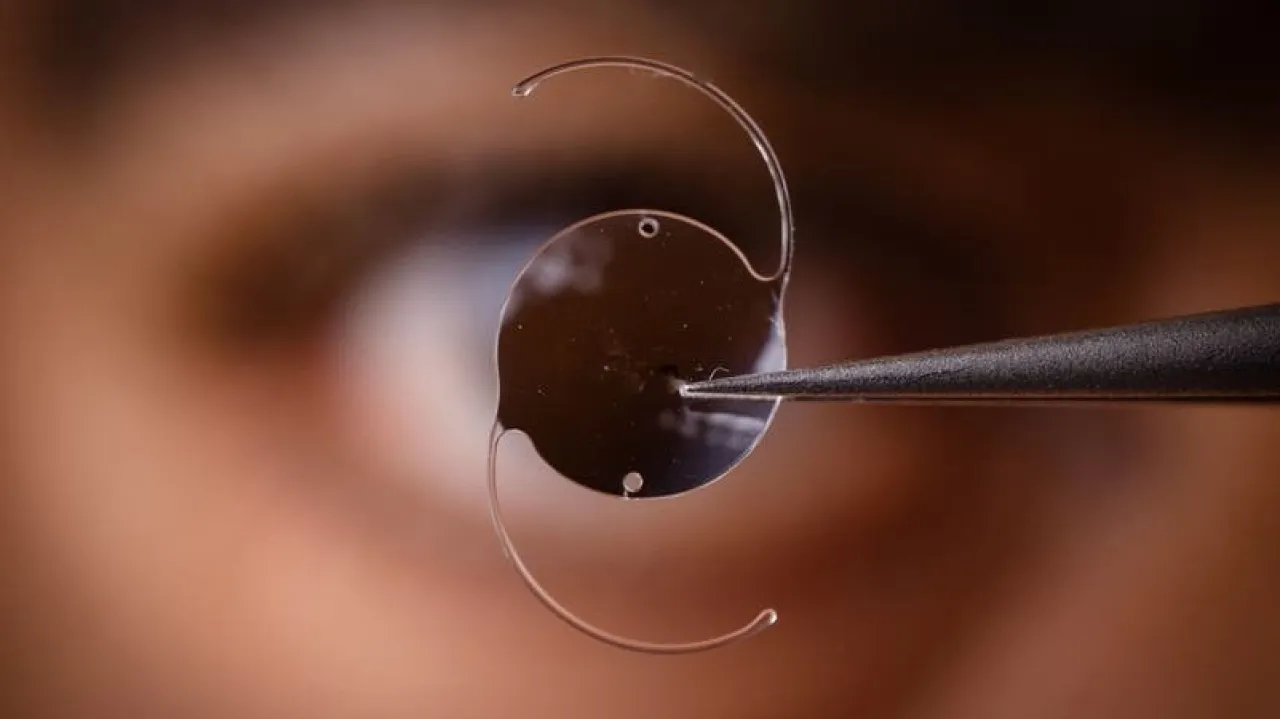
Khaberni - A group of blind patients can read again after implanting a chip in the back of the eye.
A surgeon who implanted the microchips for five patients at Moorfields Eye Hospital in London said the results of the international trial were "stunning".
This technology offers hope to people suffering from an advanced type of age-related dry macular degeneration known as geographic atrophy, which affects more than five million people around the world, according to a report by the British Broadcasting Corporation (BBC) reviewed by "Al Arabiya Business".
In this case, cells in a small area of the retina at the back of the eye gradually deteriorate and die, leading to blurred or distorted central vision. Those affected often lose the ability to perceive colors and fine details.
The new procedure involves inserting a photovoltaic chip the size of 2 square millimeters and as thick as a human hair under the retina.
Afterward, the patients wear glasses equipped with a built-in video camera. The camera sends a beam of video images in infrared light to the implanted chip at the back of the eye, which then transmits them to a small processor carried in the patient's pocket to be enhanced and made clearer.
The images are then sent to the patient's brain via the implanted chip and optic nerve, restoring some vision.
As part of the research, published in the New England Journal of Medicine, 38 patients suffering from geographic atrophy from five European countries participated in a trial to implant the "Prima" chip, which is manufactured by the "Science Corporation" biotechnology company in California.
Of the 32 patients who underwent the chip implant surgery, 27 were able to read again using their central vision. After a year, this represented an improvement of 25 letters, or five lines, on the vision test chart.