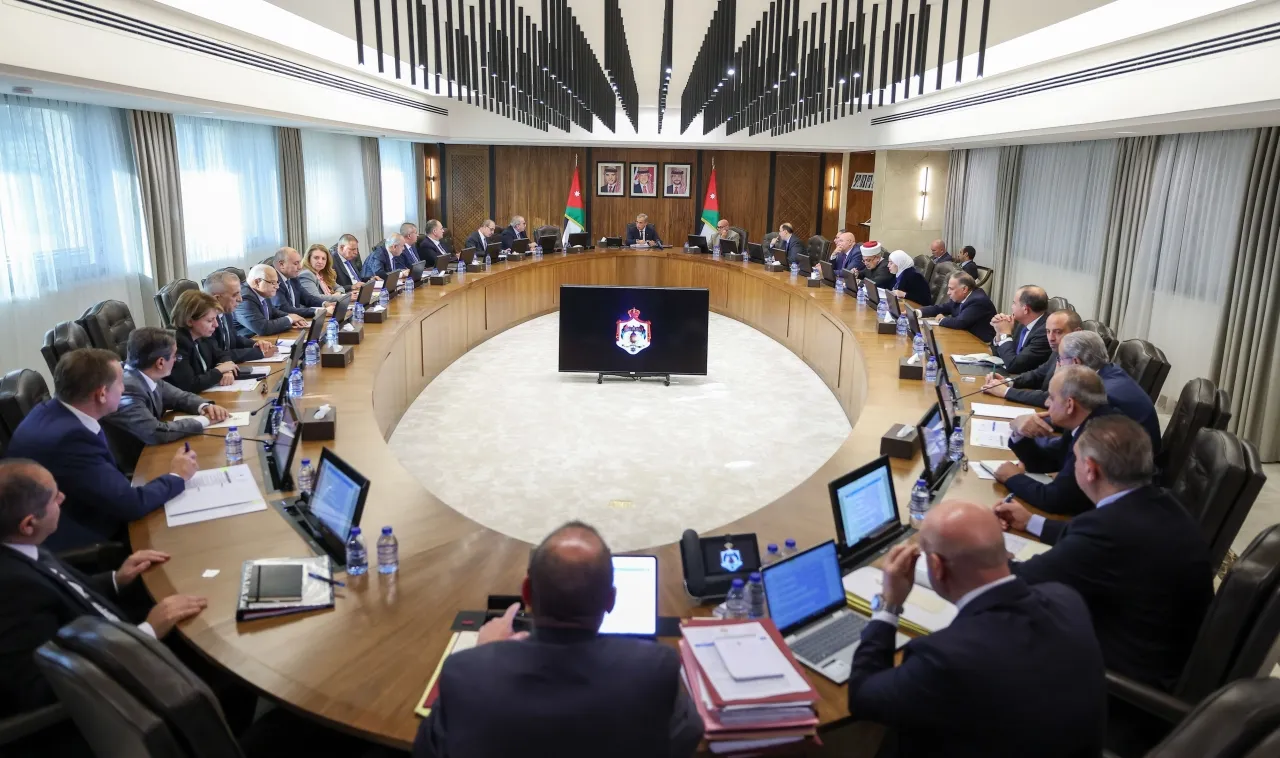
Khaberni - The cabinet in its session held today, Sunday, chaired by Prime Minister Dr. Jaafar Hassan, has approved a draft law to amend the Official Gazette Law for the year 2025.
The amending project aims to keep pace with legislative and technological updates, especially since the current law was issued in 1949, and requires many modifications to keep up with them. In addition, there is a need for a mechanism to regulate the publication process of the Official Gazette, as it is currently issued in paper and electronically.
The amendments give the electronic publication of the Official Gazette the same legal status as the printed version, as part of keeping up with modern technologies, making the electronic publication have the same legal effect as that decided for the paper publication in many legislations.
The amendments to the draft law allow the issuance of the Official Gazette by a decision of the Prime Minister whenever necessary, in addition to the current publication dates.
The cabinet also approved the planning and regulation system within the boundaries of the Greater Amman Municipality for the year 2025.
The system aims to develop a comprehensive and modern urban planning and regulation system within the boundaries of the Greater Amman Municipality, meeting the requirements of population growth; according to procedures and standards that achieve economic, social, and environmental goals within the special vision of Amman city, contributing to activating the requirements of ecosystem-based adaptation and national, regional, and local climate action within a single legislative framework.
The system contributes to facilitating the procedures related to the approval of partition and division transactions, expropriation, granting development rights, according to clear legal frameworks that ensure justice and stimulate investment and sustainable development within the boundaries of the Greater Amman Municipality.
The system also contributes to evenly distributing services across all areas within the boundaries of the Greater Amman Municipality, directing urban growth in a sustainable manner that optimally utilizes resources and facilitates procedures, and clarifying the roles between the Municipality and other government bodies to enhance coordination and provide better services that reflect on citizens' lives.
Implementing the system simplifies procedures for partitioning lands and buildings and their division through a new system and clear standards and procedures, as it also regulates the mechanism for objections clearly, granting affected individuals the right to object within known durations and clear and fixed procedures.
For the first time, the system enables the involvement of citizens and stakeholders in preparing plans through public hearings, which have been institutionalized in the new system; to ensure that they reflect the needs of the community built on consultation and consensus.
The system requires the Amman Municipality to organize public hearing sessions before adopting official plans and before taking any regulatory actions or adjustments within neighborhoods and regions, publishing everything related to plans, returns, and decisions on the Municipality's website and other official sites, taking into account the needs of men, women, elderly, children, people with disabilities, investors, and business owners.
The system achieves legal and legislative stability and unifies references which enhance the confidence of citizens and investors as it enables individuals, developers, and investors to know the expected land uses around them. The system obligates Amman Municipality to disclose any changes it makes to land use and regulation in a step that achieves transparency and justice for citizens, clearly separating planning from regulation; to enable all entities to know the changes expected on land use and regulation plans.
The cabinet decided to approve the implementation plan for the national strategy for the elderly for the years 2025-2030 and disseminate it to the ministries and governmental and non-governmental institutions concerned for its implementation and inclusion within their operational plans, in coordination with the National Council for Family Affairs.
The plan focuses on improving the living conditions of the elderly and enhancing preventive and therapeutic health care services, providing home and institutional care services, and enhancing their participation in society and public life.
It also aims to enhance the legal protection and mechanisms to protect the elderly from neglect, develop a physically qualified environment meeting their needs, build a comprehensive database to help develop effective policies, and enhance coordination between government sectors and civil organizations concerned with this segment of society.
Regarding transport and vehicle regulations, the cabinet approved an amended system for the road traffic service compensation system for the year 2025; as a completion of the necessary legislative procedures
to operate alternative roads in the kingdom, which the Ministry of Public Works and Housing had announced the start of investing in at the end of last August, to make their use optional alongside main roads.
The system prepares the legislative environment to encourage the partnership between the public and private sectors in alternative road development and operation projects, which enhances execution efficiency and service level, and reduces traffic congestion on roads due to organizing the use of the alternative road and efficiently directing traffic flow.
Alternative roads also contribute to stimulating local economic development in the areas adjacent to the new road, by improving access and attracting investments.
The cabinet also approved an amended system for driver licensing for the year 2025.
The system unifies the duration of driving licenses for the fourth, fifth, and sixth categories with those of the first, second, and third categories to all be 10 years; to facilitate the citizens.
The system aims to enhance road safety by including public transport vehicles, freight vehicles, medium private buses, and student transport vehicles requiring an annual driving permit to ensure their road safety.
The cabinet also approved the justifying reasons for the draft of the amended system for vehicle license plates for the year 2025; as a preliminary to sending it to the Legislation and Opinion Bureau, to complete the issuance procedures accordingly.
The system's amendments are in alignment with the Arabic language protection law; vehicle license plates will be coded in Arabic, and this will be applied after the issuance of the system in its final form.
The draft system will be published on the Legislation and Opinion Bureau's website, before being approved by the Legal Committee and presented to the cabinet again for approval in its final form.
In terms of international cooperation, the cabinet approved a memorandum of understanding between the Ministry of Digital Economy and Entrepreneurship and the Ministry of Digital Transformation in the Republic of Slovenia, regarding cooperation in the field of digital transformation.
The memorandum aims at exchanging expertise in the field of digital transformation, and developing a dynamic system for exchanging knowledge and technical expertise and exchanging best practices and cooperation in the fields of information technology, telecommunications, artificial intelligence, and other technologies in the public sector.
The cabinet also approved a memorandum of understanding between the Institute of Public Administration and the Ministry of Administrative Development in the Syrian Arab Republic in the area of capacity building and human resources development in the Syrian public sector.
The memorandum aims to frame Arab joint cooperation and transfer Jordanian experiences in the field of public administration to build and enhance the capacities of the Syrian public sector in the post-political stability phase.