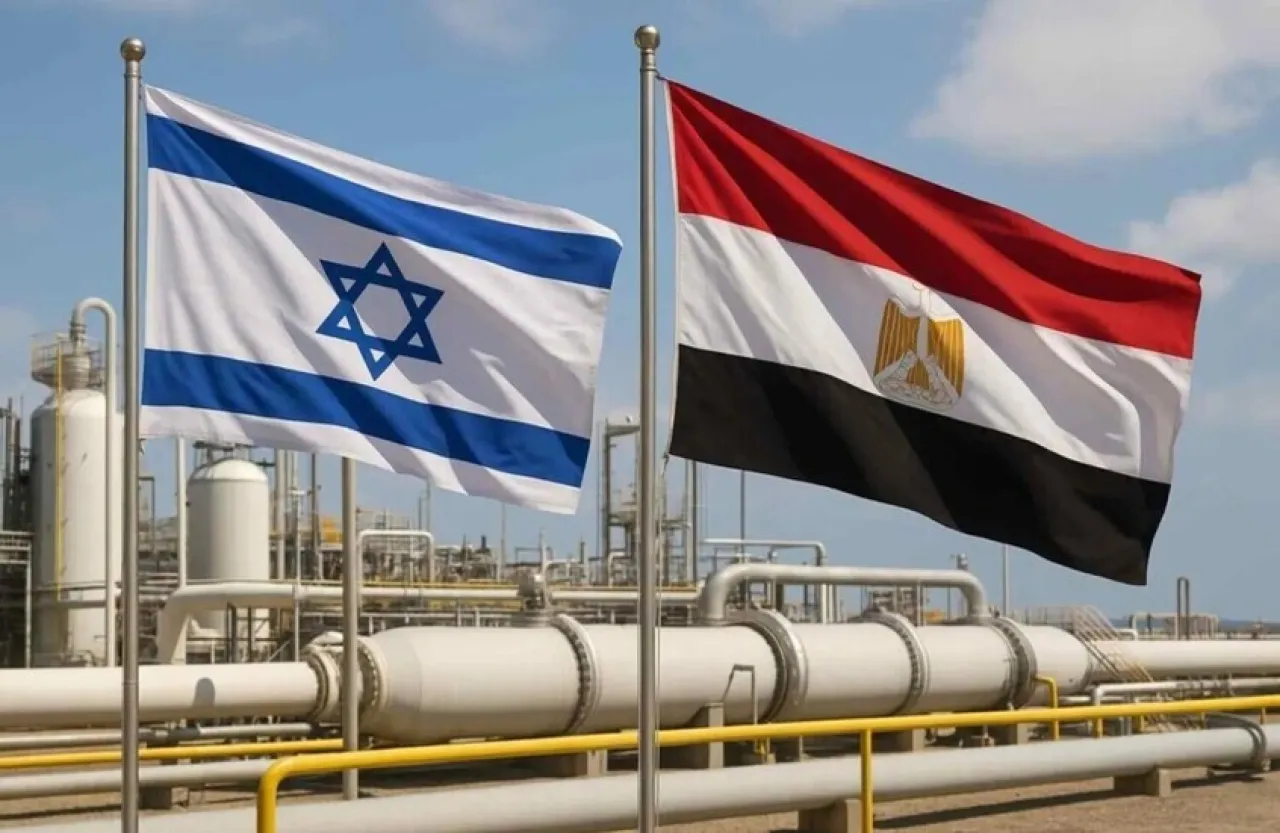
Khaberni - The Israeli economic site Bizportal mentioned that Egypt earns billions of dollars annually at the expense of Israeli gas.
The Hebrew report explained that within the framework of the complex relationship with Egypt, Israel supplies Egypt with gas through the Leviathan gas reservoir, which is also used for export, and the profit share going to Egypt is estimated at about 80%, and over the next fifteen years, Israel will supply Egypt with gas in exchange for $130 billion, part of which will go to Europe, leaving substantial amounts in Egypt.
The report added that Egypt plans to increase its exports of liquefied natural gas to Europe starting from next November.
The Hebrew site explained that this brief news, which was recently published in the American and Egyptian media, hides an important story; Egypt, which has its own gas reserves, cannot meet its energy needs, which are urgently required, so it imports gas from Israel in constantly increasing quantities. However, part of this gas is not used to meet domestic needs, as the government performs a simple calculation, seeing that exporting it to Europe and making substantial profits is worthwhile.
The report continued: "Now, with the ongoing development and expansion of the Israeli Leviathan field production, the volume of gas transported to Egypt will increase, and this was announced two months ago. Meanwhile, it appears that Egypt is preparing to increase exports, which seems like a commercial move on the surface, but there are political dimensions and a trade relationship that supports peace in reality. In the end, why does Israel give this big gift to its neighbor and not sell directly to Europe? True, infrastructure needs to be built, but from the beginning, the goal was to supply gas to its neighbors (Jordan also receives gas from Israel) as a kind of foundation for peace agreements and expanding mutual interests. Perhaps it is profitable from an overall accounting perspective—Jordan was a silent partner in defending Israel during the missile period, and Egypt pressed for an agreement to stop the Gaza war. But this is the political calculation, what about the partnership accounts—New Med, Ratio, and Chevron owning the field?"
The report followed: "Could the export to Europe have increased their profits years ago? Definitely. But exporting gas, along with questions about how much gas remains for future generations and the destination of the exports, are political issues. The global oil and gas sector is generally involved in politics. Those who own the Leviathan field have leaned towards politics."
The report added that, according to the latest reports, the Egyptian government is negotiating to ship additional quantities of liquefied gas monthly from the Edco facility in Damietta Governorate for liquefaction, starting from November until the end of March. This step comes as part of efforts to enhance cooperation with foreign companies and ensure they get a share from the joint production exports.
The report added that it's not about using additional Israeli gas exports, which will increase later on. However, one doesn't need to be very smart to realize that Egypt will have the opportunity to increase exports and increase profits, while Europe is still urgently in need of gas amid the major crisis with Russia. However, Egypt is adjusting its gas exports according to local needs, as last year, Egypt reduced export volumes amid necessary demand from local industry.
The Hebrew site pointed out that last August, a new $35 billion gas export agreement was signed between Leviathan field partners and Egypt, the largest ever in this field.
The agreement includes exporting approximately 130 billion cubic meters by 2040, in two phases: about 20 billion cubic meters in the first phase starting in 2026, and an additional 110 billion cubic meters after the construction of a new gas pipeline.
It is expected that this pipeline, named "Nitzana", will directly connect the Leviathan field with Egypt, doubling the transport capacity, with an addition of about 600 million cubic feet per day. This project, led by Chevron and Israeli companies, aims to develop the infrastructure for transportation and align exports with future growth.
According to the Hebrew report, this is critically important for Egypt, as the country needs to complete the pipeline to avoid a shortage in the local economy. This also enables Egyptian exports to operate its gas liquefaction facilities, and as previously mentioned, to export liquefied natural gas to European markets. In Europe, increasing imports from non-Russian sources has become a strategic goal since the halt of gas supplies from Russia, making Egypt—and indirectly Israel—an important alternative energy source, especially with the approaching winter.
According to forecasts, Israeli exports to Egypt are expected to exceed 12 billion cubic meters annually by 2029, which is nearly three times the quantity sold just a few years ago.
The Hebrew site added that if the new pipeline is completed on schedule, it will allow an increase in transmission capacity, increase certainty about future agreements, and facilitate the marketing of additional gas quantities to further markets. By calculation, the yearly export volume to Egypt is expected to reach an average of $9 billion over the next fifteen years, part of the gas will go to Europe, and as far as we know, it is sold at a high profit. Israeli gas is sold at a price ranging from $7.5 to $8 per thermal unit (MMBtu), and sold to Europe after the liquefaction process at a price ranging from $13.5 to $14 per thermal unit. Of course, there's the cost of liquefaction, but even after that, we're talking about a profitability between 60% and 80%, which could amount to billions of dollars annually.
The site concluded its report saying: "This situation, on one hand, represents an ongoing economic grant from Israel to Egypt, which benefits from these price differences, and on the other hand, raises difficult questions: Why doesn't Israel develop its own infrastructure for gas liquefaction to sell directly to global markets and achieve its full potential? Perhaps this is part of the price of peace."
In another context, a report by the Israeli economic site Investing said that Egypt plans to drill 480 exploratory wells over the next five years, with investments amounting to $5.7 billion during the same period, according to a statement issued by the Egyptian Ministry of Petroleum, yesterday Tuesday.
And the Egyptian Minister of Petroleum announced this at a time when the state continues to develop its energy sector.