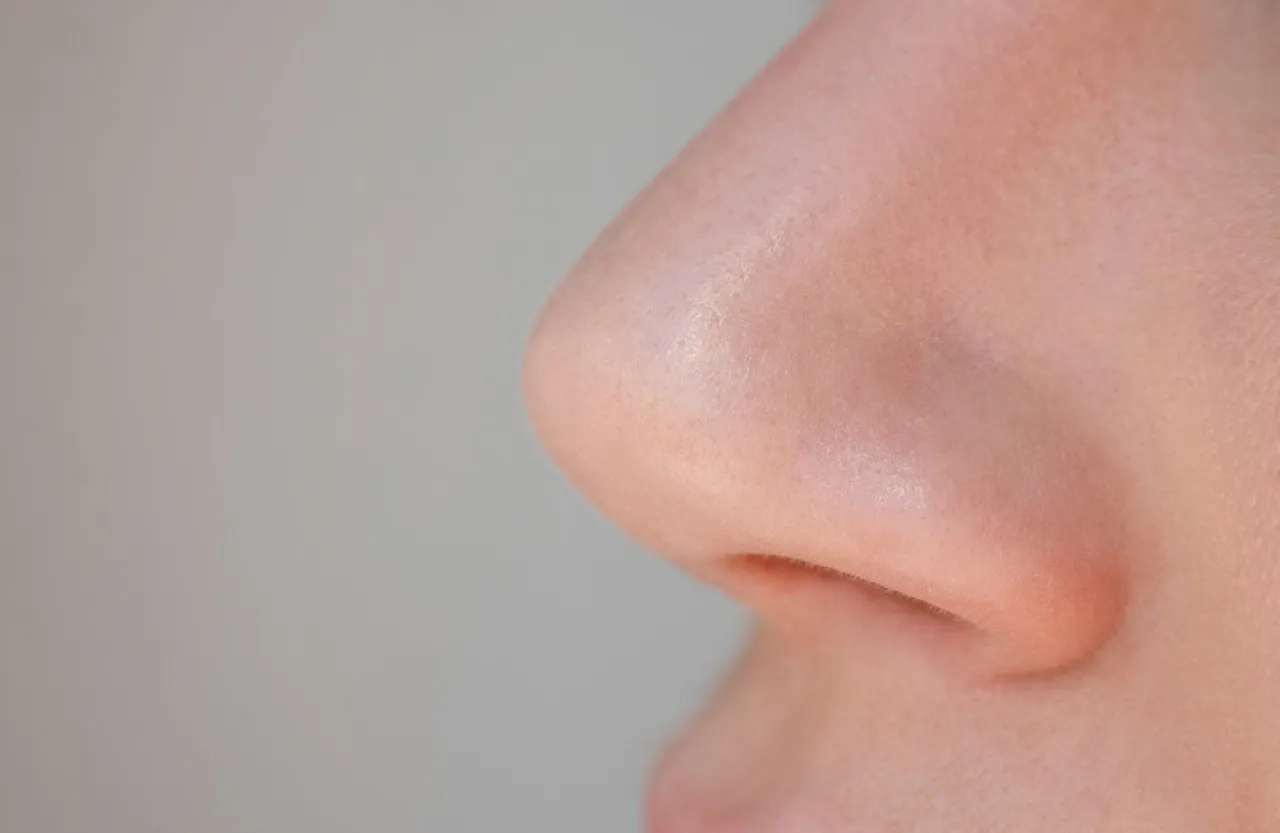
Khaberni - A scientific study has revealed that our noses become cooler when we are stressed, and that this change is significant enough to be detected through thermal imaging.
A new research from University of Sussex scientists demonstrated how blood flow to our faces changes when we experience feelings associated with stress. Using thermal imaging, the team was able to monitor the "drop in nose temperature" that consistently occurs during stressful situations.
The study included an experimental stress test, where participants were asked to listen to white noise through headphones and then given three minutes to prepare a five-minute speech about their "dream job," all while a panel of researchers silently stared at them.
At the same time, thermal imaging was used to track changes in blood flow in the face as stress levels increased among the participants. In each of the 29 volunteers, the researchers noted a decrease in nose temperature ranging from 0.3 to 0.6 degrees Celsius.
According to the researchers, changes in blood flow occur when our arousal system is activated, as human brains and bodies have evolved to respond to external stresses with increased alertness.
Since vision is the primary sensory modality for all primates, we are adapted to heighten our attention to the visual environment, which leads to a diversion of blood flow from other parts of the face.
This shift causes the blood vessels around the nose to constrict, which in turn leads to a noticeable decrease in the tip of the nose temperature compared to normal conditions.
The scientists stated that the drop in nose temperature can be used as a "direct and non-invasive (non-surgical) biological gauge of stress in real-time".
Professor Jillian Forrester, the lead researcher, is scheduled to demonstrate this decrease in front of an audience at the "New Scientist Live" event in London on October 18.
Her team told the British Broadcasting Corporation (BBC) that since it is an evolutionary response present in all primates, it could be used to measure stress levels in higher primates as well as humans.
Marian Paisley, a researcher at the University of Sussex, explained: "Monkeys cannot verbalize their feelings, and they can be skilled at hiding their emotions. We have studied primates for the last hundred years or so to help us understand ourselves. Now that we know so much about human mental health, perhaps we can use this knowledge to give back to them."