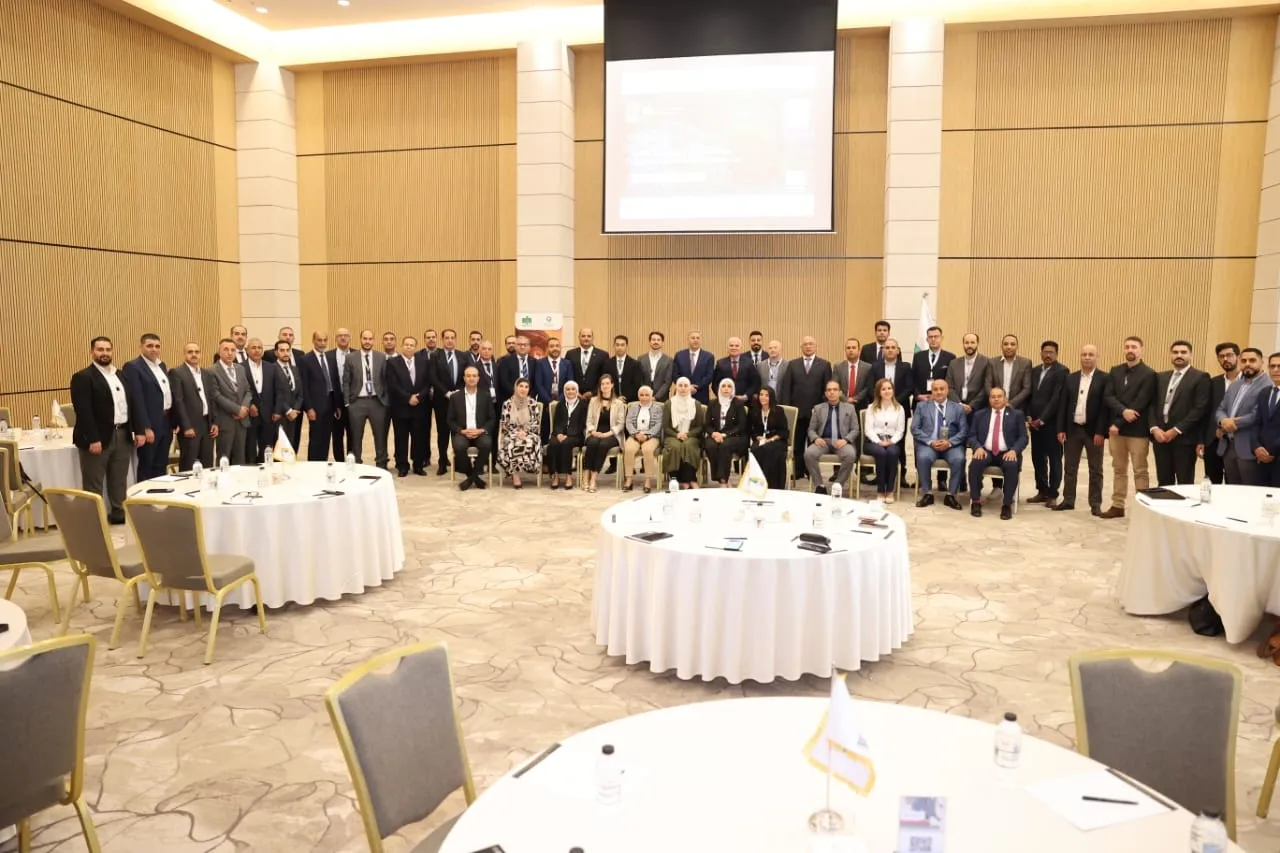
Khaberni - The Chairman of the Board of Directors of Arab Potash Company, Engineer Shahadeh Abu Hudaib, along with the company’s CEO, Dr. Maen Al-Nsour, and the Secretary-General of the Arab Fertilizer Union, Chemist Saad Abu Al-Maati, inaugurated a specialized workshop in Amman titled "Economics of Fertilizers and Future Challenges".
This workshop, which spans over three days, is organized by the Arab Fertilizer Union and sponsored by the Arab Potash Company, with attendees from industry workers and representatives of Arab and international companies.
This workshop is one of the most prominent technical and knowledge events that bring together a group of experts and representatives of Arab and international companies engaged in the fertilizer industry, to discuss the latest developments in global markets and forecast the future of this vital sector, which is a fundamental pillar of global food security and the sustainability of modern agriculture.
The workshop also features speakers from Argus, a global company specializing in market analysis and studies, alongside a number of experts in the fields of supply and demand, supply chains, and international trade trends.
Engineer Abu Hudaib emphasized that holding this workshop in Jordan reflects the position occupied by "Arab Potash" as a major player in the global fertilizer industry, and as a model in industrial and operational development. He stated, "Arab Potash Company has proven over long decades that it is a cornerstone of the national economy and a key driver of industrial growth in Jordan, with its advanced human and technical expertise placing it at the forefront of global companies in this sector."
Engineer Abu Hudaib added that the sponsorship of "Arab Potash" for this workshop comes as part of its ongoing commitment to supporting scientific and knowledge initiatives that contribute to the development of the fertilizer industry and promote constructive dialogue between producers, consumers, and decision-makers in the region and the world.
Abu Hudaib stressed the importance of experts and decision-makers meeting on such platforms to discuss the economic and environmental challenges facing the global fertilizer sector, pointing out that the sector is currently experiencing deep transformations affecting production costs, energy prices, and environmental standards, which requires broad international cooperation to exchange expertise and develop innovative solutions that ensure the sustainability of production and resource efficiency.
He added that "Arab Potash" places great importance on the concepts of innovation and sustainability in its operational processes, and ensures that its strategies align with global changes to maintain its competitive flexibility in international markets.
In turn, the Secretary-General of the Arab Fertilizer Union, Chemist Saad Abu Al-Maati, said that the world is currently experiencing an unprecedented state of interconnectedness and overlap between markets and economies, making any developments or transformations in one area have a direct and rapid impact on other regions of the world.
Abu Al-Maati explained that this increasing interconnection poses growing challenges to the global fertilizer sector, whether in terms of fluctuations in energy prices and raw materials, or geopolitical changes, or the new environmental measures that directly affect production and trade processes and pose pressure factors on the sustainability of supply chains in this vital sector.
The workshop sessions, which span over three days, cover a wide range of topics, including analyzing the factors affecting global demand for fertilizers, trends in prices and international trade, and studying raw material markets such as phosphate, sulfur, and sulfuric acid. The workshop also explores the future of green and gray ammonia and its role in the transition to sustainable energy, the impact of the Carbon Border Adjustment Mechanism (CBAM) on the industry, and discusses specialized and water-soluble fertilizer markets and developments in compound fertilizers (NPK).
The workshop program concludes with a field visit to the Arab Potash Company facilities at the Dead Sea, to learn about the latest operational technologies and environmental practices implemented by the company in line with its vision towards a more efficient and sustainable industry, and embodying its leading role in supporting the national economy and consolidating Jordan's position on the global fertilizer industry map.