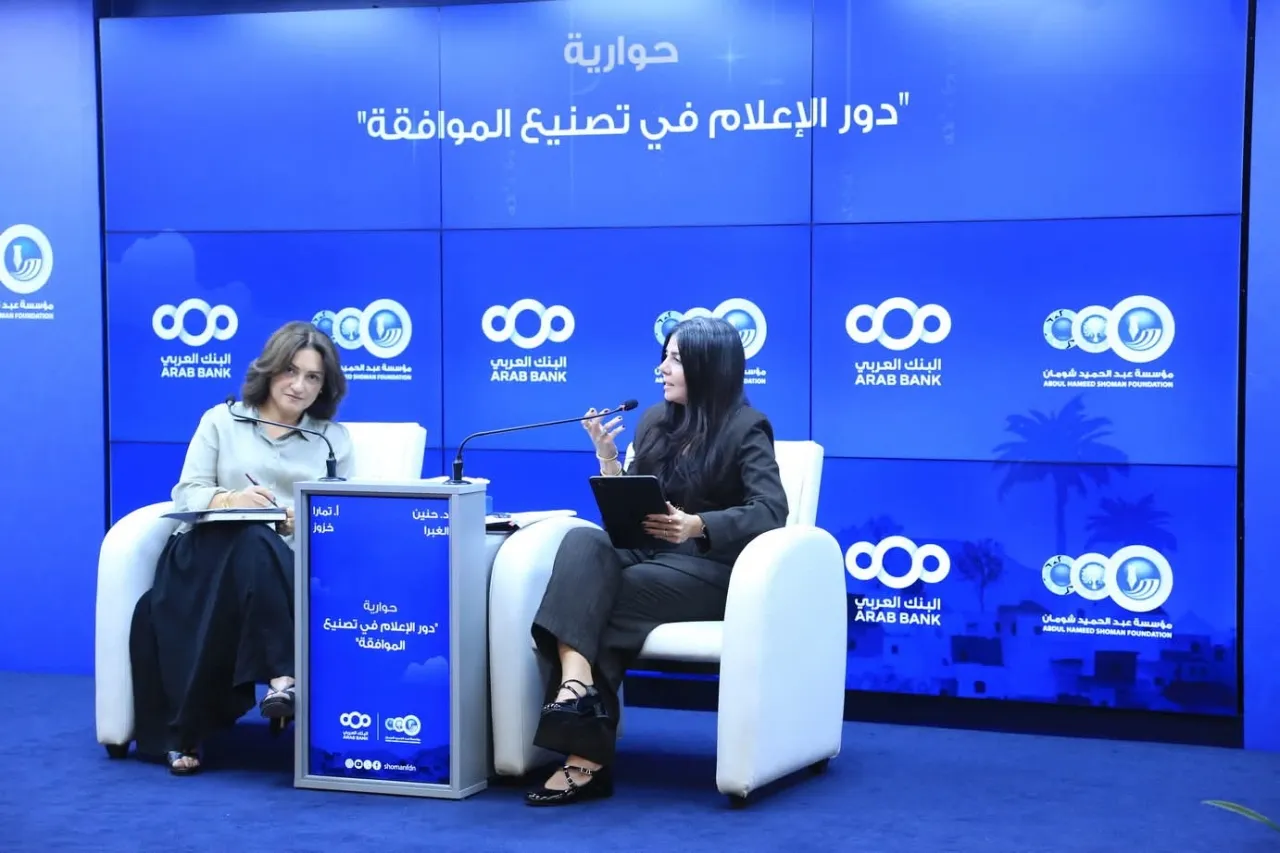
Khaberni - A dialogue at the Abdul Hameed Shoman Cultural Forum last evening, titled "The Role of Media in Manufacturing Consent", discussed media policies and the role of media in shaping and directing public opinion.
Dr. Haneen Al-Ghabra explained during the dialogue facilitated by Professor Tamara Khuzouz, that many people are unaware of the basics of media or even communication. She clarified that media is what transmits messages, creates images, and reproduces ideas to manufacture mass acceptance or "manufacture consent".
She noted that communication can take many forms, whether through art, demonstrations, advertisements, or any text we receive or see, and it is not necessarily just verbal interaction among people.
She stated that the media reproduces ideas that dominate us, clarifying that media is not neutral in major countries, as the media are owned by large companies that control everything from production to distribution. Here, the media becomes an ideological machine and a central tool in "manufacturing consent".
She added that "manufacturing consent" today operates through both traditional and digital media equally, whether via TV, newspapers, or digital platforms, pointing out that the media is a main arena for symbolic control. She also mentioned that social media platforms were once considered open spaces for resistance, but we now see how these platforms have transformed into tools for digital dominance.
Meanwhile, Khuzouz said that media today is one of the most important tools for shaping consciousness and the struggle over meaning; it is the field where dominant narratives confront counter-narratives. In a world where interests overlap among capital, politics, and technology, questions about the limits of media independence and its ability to break the cycles of symbolic domination are renewed.
She pointed out that the concept of "manufacturing consent" refers to a process through which collective consciousness is reshaped to align with the goals of power structures and their dominant discourses, through a media and symbolic system that does not rely on direct control but on guiding meaning and shaping the way people perceive and interpret reality, thus making this system a tool for domination and control.
She added that domination takes various forms—political, economic, cultural, and social—and the Western media are one of its main tools, as they reproduce power relations through language, images, and discourse, consolidating mental and stereotypical images about self and others.
The term "manufacturing consent" tops the pyramid of most important concepts in understanding the relationship between media and power, a term made famous by the well-known book by Noam Chomsky and Edward Herman published in 1988 titled: "Manufacturing Consent: The Political Economy of the Mass Media".
It revolves around the notion that the media does not merely transmit news but contributes to shaping public opinion and directing it so that people accept policies that serve political and economic elites, without feeling deceived, meaning that "the media does not force people into consent, but manufactures it through selective and structured narration".
It is noted that Haneen Al-Ghabra is a professor of Media and Cultural Studies at Kuwait University, a former assistant vice president of the university for scientific research, a prominent researcher in cultural rhetoric, discourse analysis, intersectional feminism, and has received international awards in recognition of her research on identity, symbolic domination, and representation in media.
Al-Ghabra holds a Ph.D. in Communication Studies from the University of Denver in Colorado, and a Master's degree in Public Communication from the American University in Washington.