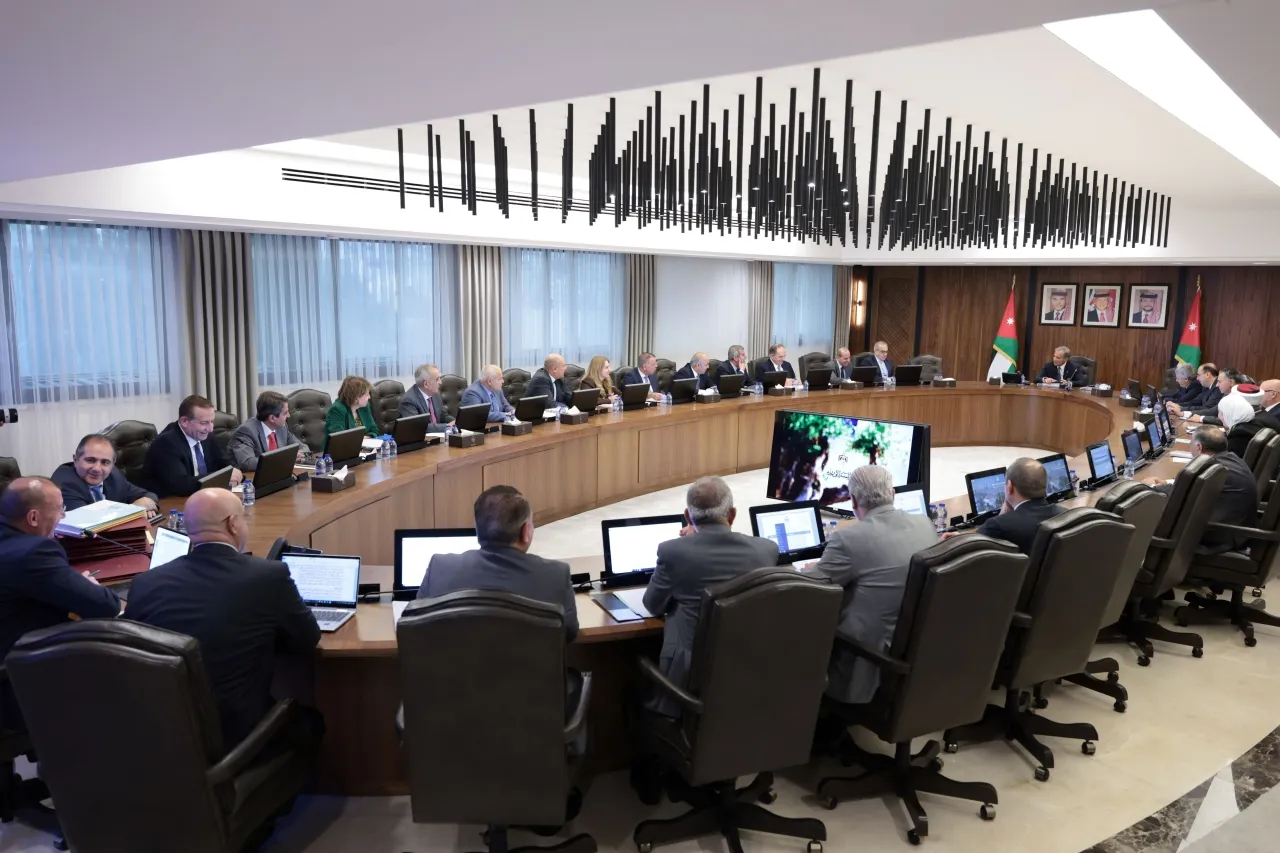
Khaberni - The Cabinet decided in its session held today, Sunday, chaired by Prime Minister Dr. Jafar Hassan, to approve the expansion of the Rural Economic Development and Employment Project / Phase Three.
The project, implemented by the Jordanian Institution for Economic Project Development (JIDCO) with funding from the International Fund for Agricultural Development (IFAD) worth $15 million, aims to build the technical and competitive capacities of small farmers and medium and small agricultural companies to provide job opportunities for Jordanian youth across different governorates of the kingdom.
The project will be implemented over six years, with 30% of the project's programs allocated to initiatives that directly contribute to adapting to climate change or mitigating its impacts.
The project aims to improve the prospects for establishing projects in rural areas by building the technical and competitive capacities of small farmers and small and medium agricultural companies, and providing job opportunities in rural areas for youth and women, in addition to contributing to economic growth, increasing income, and enhancing agricultural exports.
The project targets rural families, women, youth, and small farmers who are producers and manufacturers of vegetable and fruit crops, who work in the agriculture sector and who do not have a stable source of income or any economic activities.
The project contributes to the development and capacity building of rural families, and provides technical and financial support to small farmers, associations, producers, exporters, and companies, in addition to promoting and marketing their products, which contributes to achieving economic growth, increasing income, self-employment, and improving living standards for rural families and for women and youth.
Since its establishment, the project has provided over 7,000 direct job opportunities, and offered more than 2,000 grants for establishing productive, entrepreneurial, water harvesting and aquaculture projects, and rehabilitating irrigation networks and wells. It also financed more than 2,300 small agricultural projects and trained farmers and exporters to obtain quality certifications and standards.
To alleviate the burdens on citizens, the Cabinet decided to amend its previous resolution related to freezing the assets of debtors for the Public Treasury Directorate in the Ministry of Finance, so that the freeze on the amount of debt only applies to immovable assets or to the closest equal value of the debt from available real estate for seizure, and not as previously to an amount exceeding the value of the debt.
The freeze on movable assets will continue as currently practiced, where the seizure of the debtor's assets is equal to the amount of the debt.
The decision was made to lighten the burden on debtors and to facilitate the procedures for collecting due financial amounts.
The decision required an original settlement to lift the seizure on the properties that have been seized by providing the necessary guarantees to preserve the treasury's rights, and by bringing an appraisal value issued by the competent authorities that includes the value of the seized assets accordingly.
The Cabinet also agreed on a €30 million financing transfer agreement between the Ministry of Finance and the German Development Bank to support the desalination and water transfer project from Aqaba to Amman (the national water carrier), in addition to measures to integrate people with disabilities into the education sector in Jordan.
Of this funding, €25 million will be allocated to the national water carrier project, and €5 million to support the measures for integrating people with disabilities into the education sector.
This agreement is part of the government's efforts to secure the necessary financing to implement the national water carrier project, which is one of the most important national strategic projects, and will desalinate and transfer water from Aqaba to the capital Amman to provide 300 million cubic meters annually; this contributes to addressing the water shortage and increasing water supplies for all provinces.
Additionally, the Cabinet approved the acceptance of a $11 million grant from the Government of the Republic of Korea to fund the construction of the Korean-Jordanian Institute for Engineering Training and Technology at the University of Jordan.
The project comes within the framework of the friendly and cooperative relations between the two countries, and the joint keenness to develop education through the establishment of an institute for engineering training, which will contribute to improving the quality of engineering education at the University of Jordan, and creating an appropriate environment for teaching students according to best practices.
The establishment of the institute aims to develop and introduce advanced education and training models that align with the job market needs and assist students in finding employment opportunities demanded by the changing business reality inside the kingdom and abroad.
In terms of international cooperation, the Cabinet agreed on the measures related to establishing a global UNICEF office, and the new UNICEF regional office for the Middle East, North Africa, Europe, and Central Asia in the capital Amman.
The decision is part of enhancing cooperation with UNICEF and enabling it to implement its programs to support childhood both in the kingdom and the region, as part of Jordan's role in supporting international organizations and their varied developmental and humanitarian efforts, and capitalizing on the kingdom's capacities in infrastructure, international presence, and high political credibility.
The Cabinet also approved the draft law ratifying the extradition agreement between the government of the kingdom and the government of the Republic of Uzbekistan for the year 2025; in preparation for its referral to the House of Representatives to proceed with the ratification procedures accordingly.
The draft law aims to enhance cooperation between the two countries in the field of crime prevention and ensuring justice and facilitating the extradition of persons in accordance with constitutional principles.
The Cabinet agreed on a memorandum of understanding to be signed between the Ministry of Environment and its counterpart in the Republic of Rwanda regarding cooperation in the field of environmental protection and climate change.
The agreement is part of enhancing friendly relations between the two countries and developing cooperation in the field of environmental protection and climate change, providing clean energy, and managing natural resources, according to national legislation and the obligations arising from international treaties regulating this.
The cooperation areas between the two countries according to the agreement include: environmental protection and sustainable management of natural resources, mitigating the impacts of climate change and adapting to them, exchanging expertise in land and forest management, meteorological services and climate sciences, monitoring air quality and combating pollution, and developing renewable energy.