Khaberni - A recent report confirmed that China has solidified its position as a global power in the field of industrial robots, having installed approximately 295,000 robots during the year 2024 alone, more than half of the total robots installed around the world during the same year, amounting to 542,000 units, with an increase of 9% compared to 2023.
China now possesses the largest fleet of industrial robots in the world, totaling more than 2.03 million robots, significantly ahead of Japan (450,000) and the United States (400,000) and South Korea (392,000).
This leap in reliance on robots coincides with a decline in China's population by about 1.39 million people during the year 2024, leading to a shrinkage of the industrial workforce, according to a report published by "gizmochina" and reviewed by "Al Arabiya Business".
Experts confirm that automation has become a necessity to maintain productivity in vital industries such as automotive, electronics, and logistics, where robots are used in welding, heavy transport, and precise assembly operations.
Professor Gao Shuo Dong from Tsinghua University said that robots will take over simple and repetitive tasks, while creative and complex jobs will still require human intervention.
Experts anticipate that by 2030, China will face a shortage of 50 million skilled workers in high-tech industrial sectors, especially in the operation, maintenance, and programming of robots, making training a national priority to support the transition towards smart manufacturing.
From biggest consumer to biggest producer
China is no longer just the largest user of robots but has also become the largest global producer, surpassing Japan for the first time in 2024.
Its share of global industrial robot production rose from 25% in 2023 to about one-third in 2024.
This is due to the expansion in the manufacturing of components locally such as motors, sensors, gears, and control units, which has lowered costs and aided Chinese companies like "Xiaomi" and "BYD" in operating fully smart factories known as "dark factories," which operate automatically without human intervention.
The new generation: humanoid robots
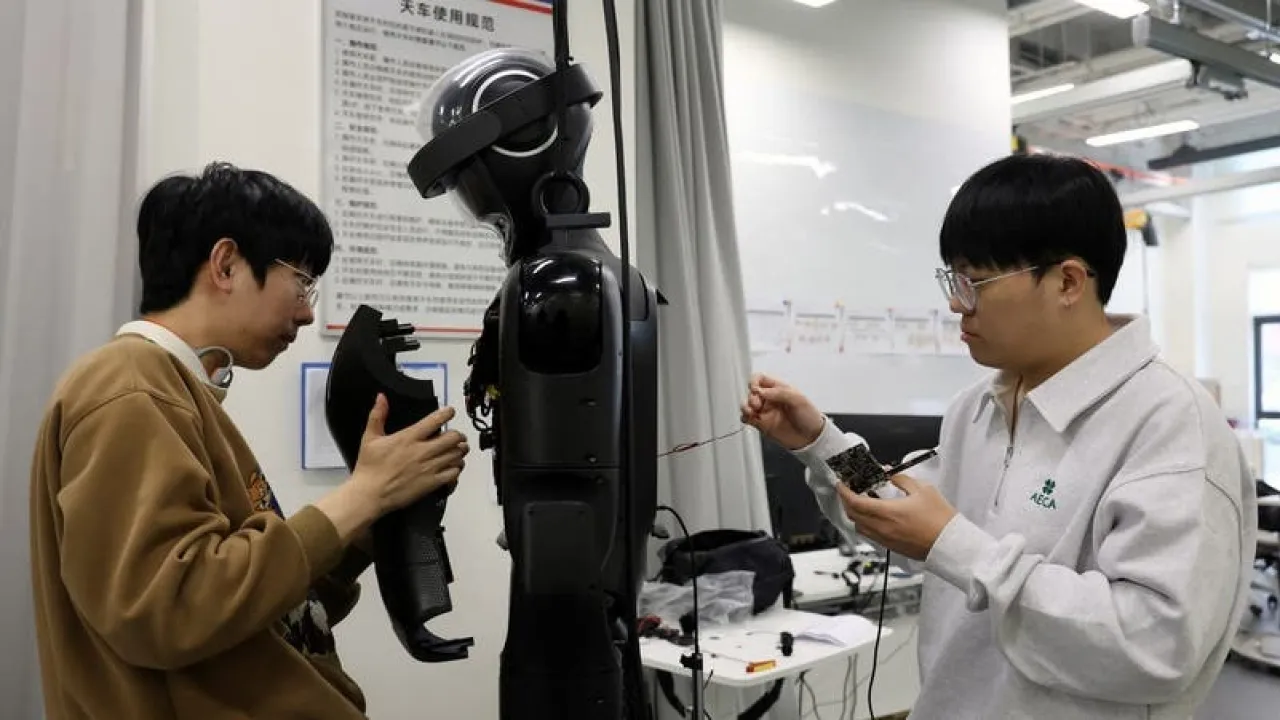
2024 also saw an expansion in humanoid robots, as Tiantai Robot in Guangdong province announced the largest commercial order in China's history for the production of 10,000 humanoid robots, most of which are designated for elderly care services, representing a transition from the research phase to actual commercial use.
The United States installed only 34,200 robots during 2024, highlighting the growing gap with China.
Analysts believe that China's pace in deploying robots creates what is known as the "data wheel effect," where widespread use leads to the accumulation of massive data that is used to rapidly improve artificial intelligence and robotics.
Experts caution that China's dominance in the physical realm of artificial intelligence and robotics may grant it a strategic advantage in global manufacturing, urging the United States to invest in developing actual robots and not just software to maintain its competitive edge.