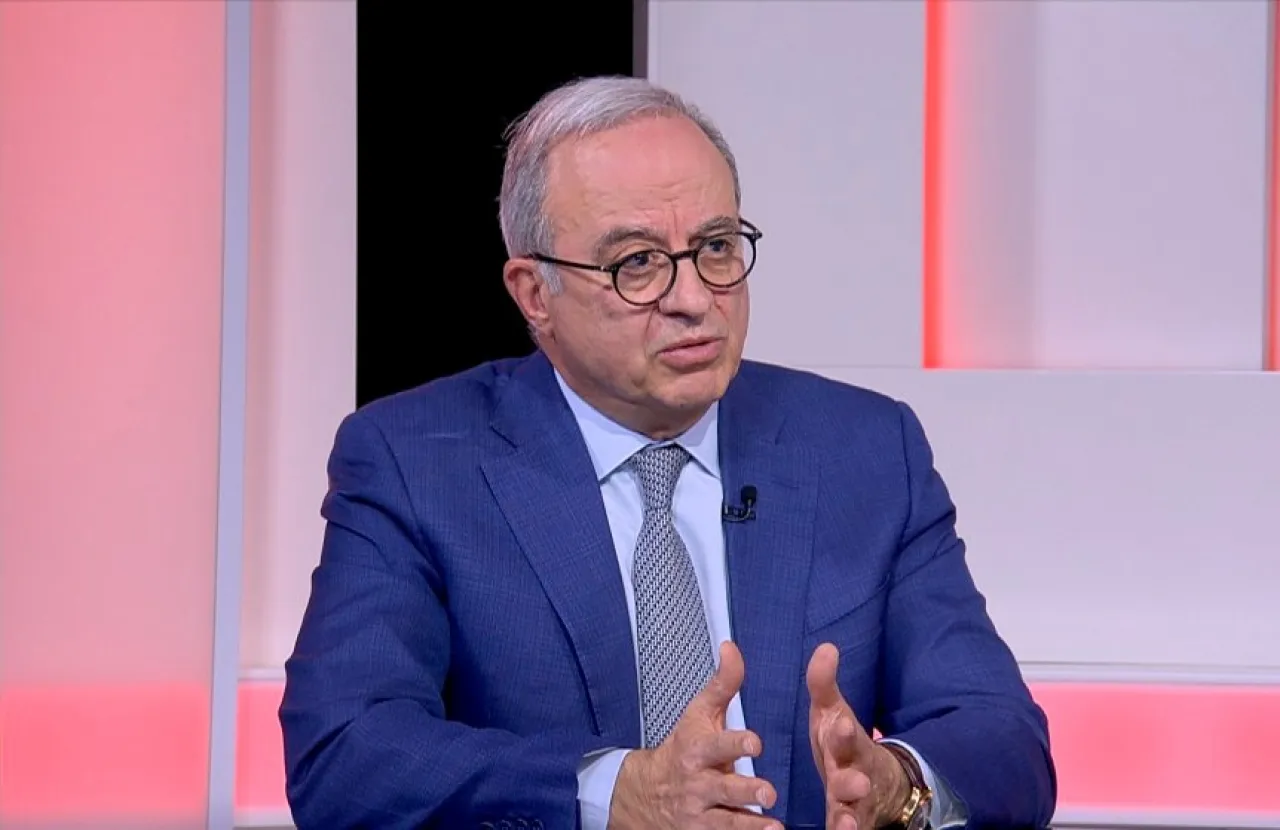
Khaberni - Former Deputy Prime Minister, Dr. Marwan Al-Muasher, said that the justification for the normalization agreements with Israel was based on the idea of "softening the Israeli stance" by making it more moderate and acceptable towards Palestinians; however, these justifications are no longer convincing to the people, especially in the Gulf countries.
He explained in his speech during a political seminar attended by Khaberni in the Jordanian Administrative Leadership Association, that the justification for the presence of American bases before and after the normalization agreements was based on them protecting the region from Iran and Israel. However, the bombing of the Qatari capital raises questions about whether the Gulf states will revise their positions on these agreements, considering that the answer remains open, according to Khaberni.
- Wadi Araba.. and the Two-State Solution –
He clarified that the Wadi Araba Treaty included in Article Six the prevention of the mass displacement of Palestinians.
He said that Jordan's cancellation of the treaty with Israel would have consequences that it might not afford, but he stressed at the same time that "it is impossible to justify the gas and water agreements with Israel, which cut them off from the Gaza Strip and threatened Jordan with them".
And he pointed out that the world repeatedly talks about the two-state solution without a clear implementation plan, adding: "The two-state solution has been dead for a long time, I say this responsibly because I have worked on the file for many years."
He explained that achieving fair peace requires ending the occupation and the Israeli withdrawal and separation between the Palestinian and Israeli sides, which are conditions "no longer realistic under the current circumstances."
He sees that the official Jordanian stance clinging to the two-state solution comes in an attempt to avoid alternative solutions that may be imposed at the expense of Jordan, adding: "The realistic alternative solution, in my view, is the one-state solution."
He added: "The two-state solution needs extensive diplomatic work, while the one-state solution is imposed by reality, and what is required is to transform this reality into a fair democratic system."
He asserted that if the adherence to the two-state solution continues, it is necessary to continue supporting the resilience of the Palestinian people materially and politically, through Arab coordination that is still absent so far.
And he talked about the weakness of the unified Arab stance during the past years, pointing out that the war on Gaza contributed to a kind of coordination that was not present before.
- Modernization programs.. and requirements –
Domestically, Al-Muasher questioned the ability of Jordan's rentier system to continue in the wake of declining foreign aid and grants.
He also wondered about the future of the Jordanian education system, which "is no longer at the level we once were proud of", explaining that the discussion about education often turns to "affecting customs and traditions" instead of addressing the fundamental flaws in the education system.
He said: "The outcomes of economic modernization projects did not contribute to reducing unemployment rates but raised them by additional percentages", considering that "difficult questions must be raised clearly before talking about any real reform".
In his talk about political modernization, Al-Muasher recalled the outputs of the National Charter Committee as "a very serious attempt although it was the result of an unelected committee", indicating that "its outputs included advanced provisions on our current reality after 35 years".
He added that "the Charter was supposed to be legalized", followed by the National Agenda which broke the monopoly of a single voice and declared clearly: "No economic reform without political reform".
He explained that political reform cannot be achieved "overnight", but must be organic starting from the grassroots, warning that "formal, inorganic parties will ultimately end".
He continued: "I see minor personal disputes within parties that show our long way towards real political modernization", emphasizing that the goal of modernization should be to create leaderships capable of monitoring the executive power and promoting free media."
He added: "In the last century we used to write things we don't dare to write about today", noting that political modernization is necessary for the future of Jordan and without gradual and responsible reform, our future will not be clear."
And he called for a comprehensive national review involving the Jordanian people logically through a realistic path, affirming that "managing the stage should not remain solely on the shoulders of His Majesty the King alone."