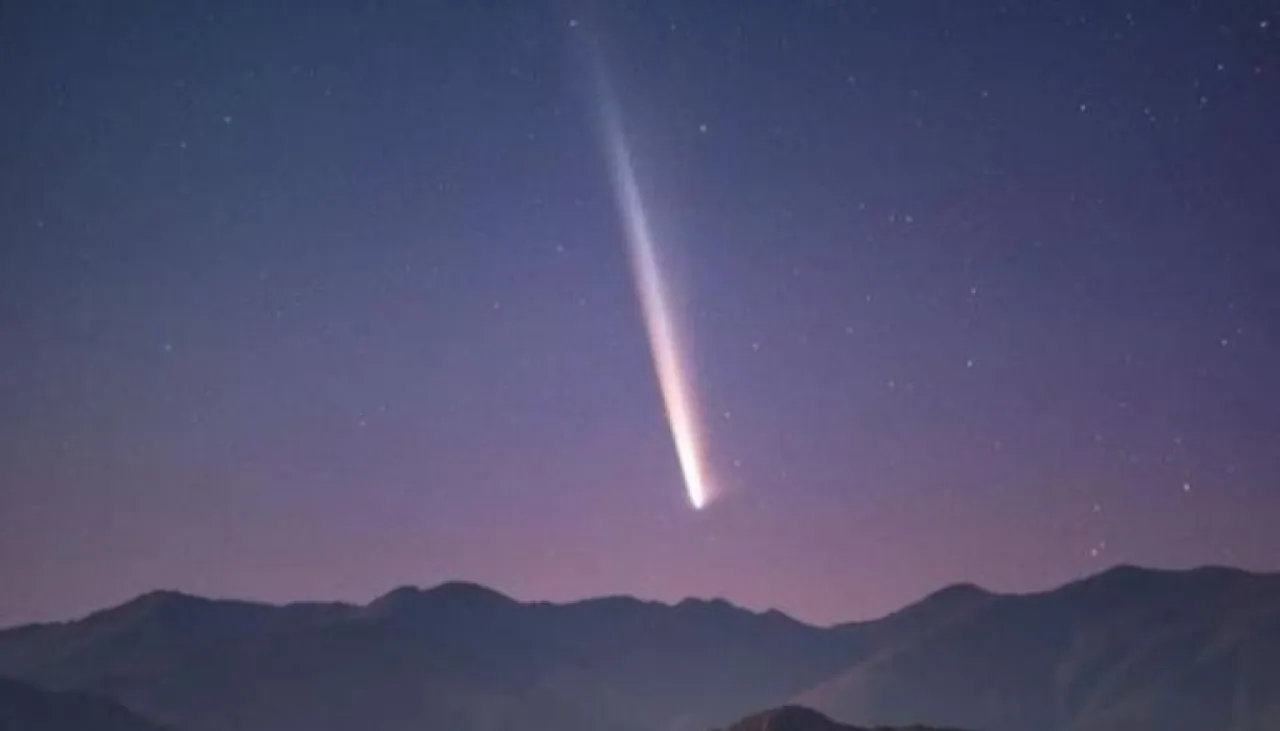
Khaberni - This month, the world is witnessing an important astronomical event as a new comet named "Lemon" approaches Earth.
The comet may become visible to the naked eye, according to some scientists' predictions and features a lemon green color that glows, making it look like a glowing citrus fruit in the sky.
The comet "C/2025 A6 (Lemon)" was first spotted on January 3 by a team at the Mount Lemon Sky Center in the Santa Catalina Mountains in Arizona, while it was rushing toward the inner solar system at a speed of 209,000 km/h.
This comet is classified as "non-periodic," meaning its rotation period around the sun changes and takes more than a thousand years, with scientists estimating its current cycle at 1350 years, most of which is spent in the Oort cloud, a remote area on the edge of the solar system.
Comet "Lemon" will reach its closest point to Earth on October 21, where it will be 90 million km away, 230 times farther than the moon, and a few weeks later, on November 8, it will reach its closest point to the sun (the perihelion) before beginning its long journey back to the outer edges of the solar system.
Recent images of the comet show a bright green glow, likely due to the presence of diatomic carbon in its gaseous envelope.
Recent years have seen several green comets, including the comet "C/2022 E3" and the comet "12P/Pons-Brooks".
As the comet approaches the sun, its brightness will increase due to the expansion of the surrounding gas and dust cloud, making it reflect more sunlight towards Earth. Its brightness is expected to reach magnitude 5 on the brightness scale, which makes it somewhat faint for naked eye visibility, but some experts expect its brightness to reach magnitude 4 - a level sufficient for visibility without observational equipment.
The comet "Lemon" can currently be seen using most astronomical observation equipment, and will become clearer as its brightness increases in the coming weeks. It will be visible in the Lynx constellation, between Jupiter and the stars in the Big Dipper, peaking in brightness in mid-October. Experts advise astronomy enthusiasts in the northern hemisphere to try detecting it before sunrise or just after sunset.