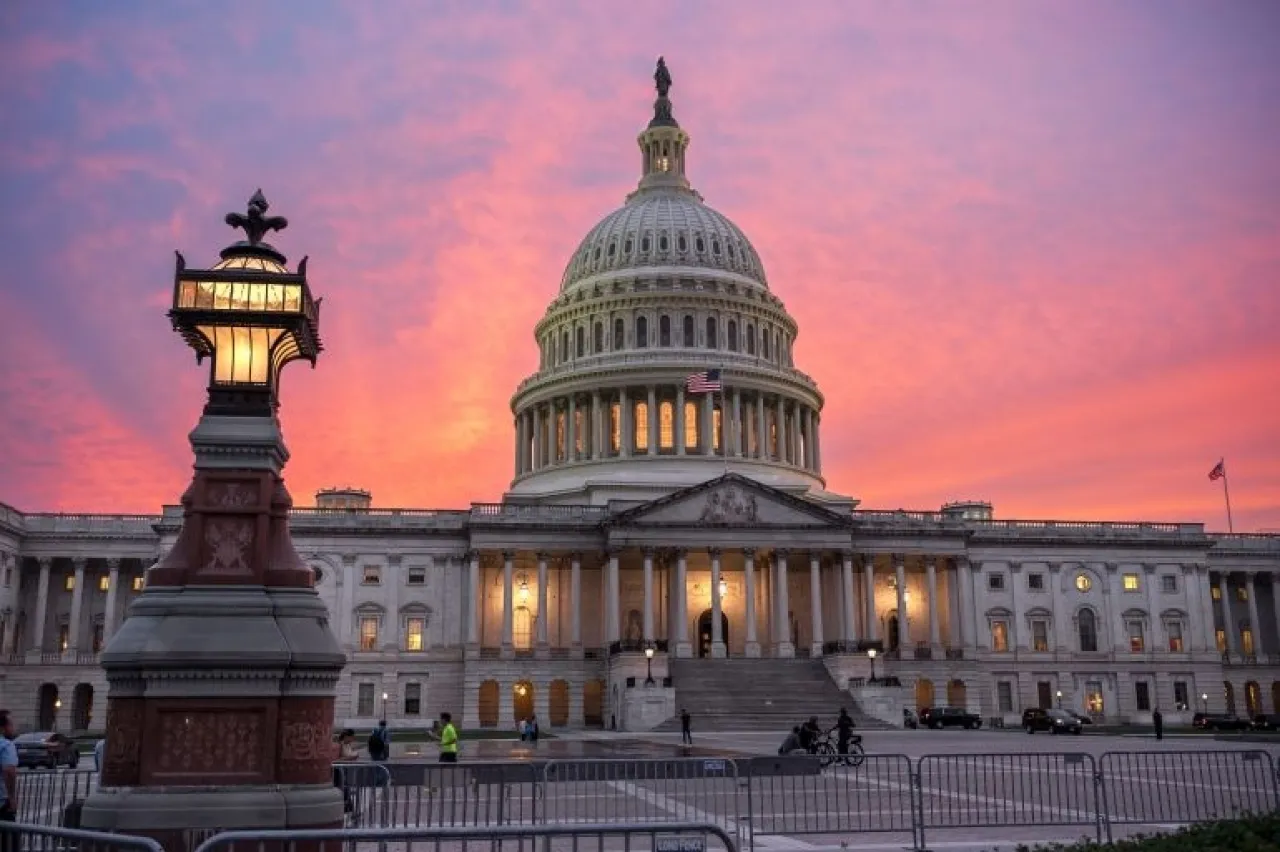
Khaberni - The United States entered an official federal shutdown early Wednesday after Congress failed to pass a bill to extend government funding, leading to the cessation of work in federal ministries and agencies and forcing hundreds of thousands of employees on unpaid mandatory leave.
This shutdown is the first in seven years and is the most extensive since the record shutdown of 2018–2019 that lasted 35 days.
The shutdown occurred after the Democrats obstructed a temporary funding bill proposed by the Republicans for not meeting their demands, while President Donald Trump and the Republican Party members held their ground on healthcare funding, deepening the confrontation and failing the budget extension.
What is a government shutdown?
A government shutdown happens when Congress fails to pass the 12 annual financial appropriation laws (or pass temporary funding known as "continuing resolution") that fund discretionary government programs.
Under the Antideficiency Act, agencies cannot spend money without Congressional approval, which forces them to halt their activities once funding stops.
But the most important question: What does the shutdown mean for investors? And what are its implications on the American financial markets?
Direct impact on employees and the economy
The shutdown is expected to force up to 750,000 federal employees to stop working, while workers in critical sectors such as security, defense, and health services continue to work without pay until the government reopens.
Economists fear that the shutdown will lead to a decline in consumer confidence and disrupt government programs and essential services like issuing passports and visas, alongside slowing down research and health activities.
Wider economic repercussions
According to Bloomberg News, the shutdown could exacerbate pressures on the American job market already suffering from a slowdown in employment, and could hinder the upward trajectory of the American stock markets.
The American Consumer Confidence Index decreased in September to its lowest level in five months at 94.2 points amid escalating concerns about jobs and economic prospects.
The publication of important economic data, such as the monthly employment report and inflation report, is expected to be delayed, depriving the Federal Reserve of key indicators for determining interest rate policies.
What should be monitored?
Bloomberg News Agency states that the job market remains a concern for Americans. The Consumer Confidence Index fell in September to its lowest level in five months amid growing concerns about job opportunities and economic prospects.
For the second month in a row, the number of unemployed slightly exceeded the number of available jobs, a situation the country has not seen since early 2021 when it was recovering from pandemic repercussions.
In a separate report released Tuesday, government data showed that the number of vacant jobs did not change significantly in August, while employment remained weak, indicating a gradual decline in demand for labor.
The employment rate last month dropped to 3.2 percent, the lowest since June 2024, while dismissal rates remained at low levels.
What stops and what continues during a government shutdown?
The current government shutdown is expected to be more severe than most previous shutdowns. It is the first since the Obama administration that begins with the start of the fiscal year or quarterly or even the new month. So far, Congress has not succeeded in passing any of the 12 financial appropriation laws that fund various government agencies.
This means that the shutdown will not be limited to some sectors but may include a broad range of federal agencies, threatening to disrupt essential services and delay important government programs at a time when the American economy is experiencing increased pressures on the job market and consumer confidence.
President Donald Trump intensifies the pressure by threatening a permanent expulsion - rather than a temporary leave - of non-essential federal workers whose jobs are unfunded.
The sectors affected by the shutdown include:
The Ministries of Education, Interior, and Commerce.
Agencies such as NASA, the Environmental Protection Agency, and the National Park Service.
Monitoring operations at the Securities and Exchange Commission (SEC).
Services for issuing passports and visas.
Major health research programs.
The excluded sectors include:
Military and security activities and border protection.
Food inspection operations.
Mail services and government borrowing operations.
Institutions such as the Federal Reserve and the Consumer Financial Protection Bureau, as they rely on independent funding sources.
Financial markets in the sight of disturbance
Analysts believe that the continuation of the shutdown for an extended period will lead to disruptions in financial markets, potentially driving American stock exchanges to sharp declines amid escalating concerns about growth and government spending.
Reports also warn that the disruption of economic data collection will increase uncertainty for investors and policymakers, potentially intensifying market volatility in the coming weeks.
Among the Department of Labor agencies likely to be completely shut down is the Bureau of Labor Statistics, according to an emergency plan issued in March 2025 under the Freedom of Information Act. The shutdown will likely delay the issuance of the employment report for September scheduled for release next Friday, and if the shutdown persists, it may also delay the expected inflation report in mid-month.
Data collection operations will also cease, which will affect the quality of statistics for months to come, leaving the Federal Reserve without reliable data to help guide the path of interest rates. Policymakers and investors, who rely on data, will have to resort to private sources to fill the gaps in assessing the health of the economy.
The Federal Reserve
The work of the Federal Reserve will not be affected by the government shutdown, meaning the central bank will continue adjusting interest rates, regulating bank operations, and conducting economic research. The Consumer Financial Protection Bureau (CFPB), funded by the Federal Reserve, can also remain open, although its activity has been significantly reduced under Trump’s administration.
Congress
Although Congress's authority to fund itself will also end, it must continue working to be able to end the shutdown.
But other Congress-affiliated agencies — such as the Library of Congress and the United States Botanic Garden — will likely close their doors to visitors.
Regulatory bodies
Although the Trump administration tightened its grip on independent regulatory agencies, previous shutdown plans stated that the Federal Trade Commission (FTC) would halt most of its investigative activities.
The Securities and Exchange Commission (SEC) will not review or approve filings from investment advisers, brokers, transfer agents, rating agencies, investment companies, or financial advisors to municipalities and local governments.
The Commodity Futures Trading Commission (CFTC) relies on a legal opinion issued in 1995, considering the supervision functions of the markets necessary to prevent "massive disruptions and losses to the private economy, in addition to disrupting many aspects of society and private activities, leading to incalculable suffering and losses."
The Consumer Product Safety Commission (CPSC) will remain able to issue product recall orders that pose "an imminent threat to human life safety," but routine monitoring operations will cease.
Treasury Department
In previous shutdowns, the Treasury Department continued government borrowing and debt servicing, in addition to the political operations and other tasks necessary to execute the president’s constitutional powers.
Energy sector
The department may continue to issue some offshore oil and gas exploration permits, but this will depend on factors such as safety requirements and government ownership rights in the wells.
In contrast, the Energy Information Administration (EIA) is expected to cease operations as it is already suffering from report delays due to staff shortages.
The Nuclear Regulatory Commission (NRC) will stop granting licenses, certifications, and permits, as well as inspection activities and emergency response training. Meanwhile, the National Nuclear Security Administration (NNSA) will focus on maintaining and securing the military’s nuclear arsenal and naval reactors.
Federal Courts
The spokeswoman for the U.S. Supreme Court, Patricia McCabe, announced that the court, which begins its new term on October 6, will continue to operate normally if the shutdown persists for a short period.
Lower courts may rely on reserve funds not subject to annual appropriations, but these could run out if the shutdown lasts, potentially hindering the administration of justice.
Federal employees
In previous shutdowns, about 4 out of 10 federal employees were laid off and prohibited from performing any work under a law that bans agencies from accepting voluntary work.
However, 6 out of 10 employees continue to work as they are considered essential employees.
Nevertheless, no employee will receive their salary during the shutdown period. But the 2019 Fair Treatment of Government Employees Act reinstated an old practice that mandates retroactive salary payment after the shutdown ends, whether the employees worked or not.