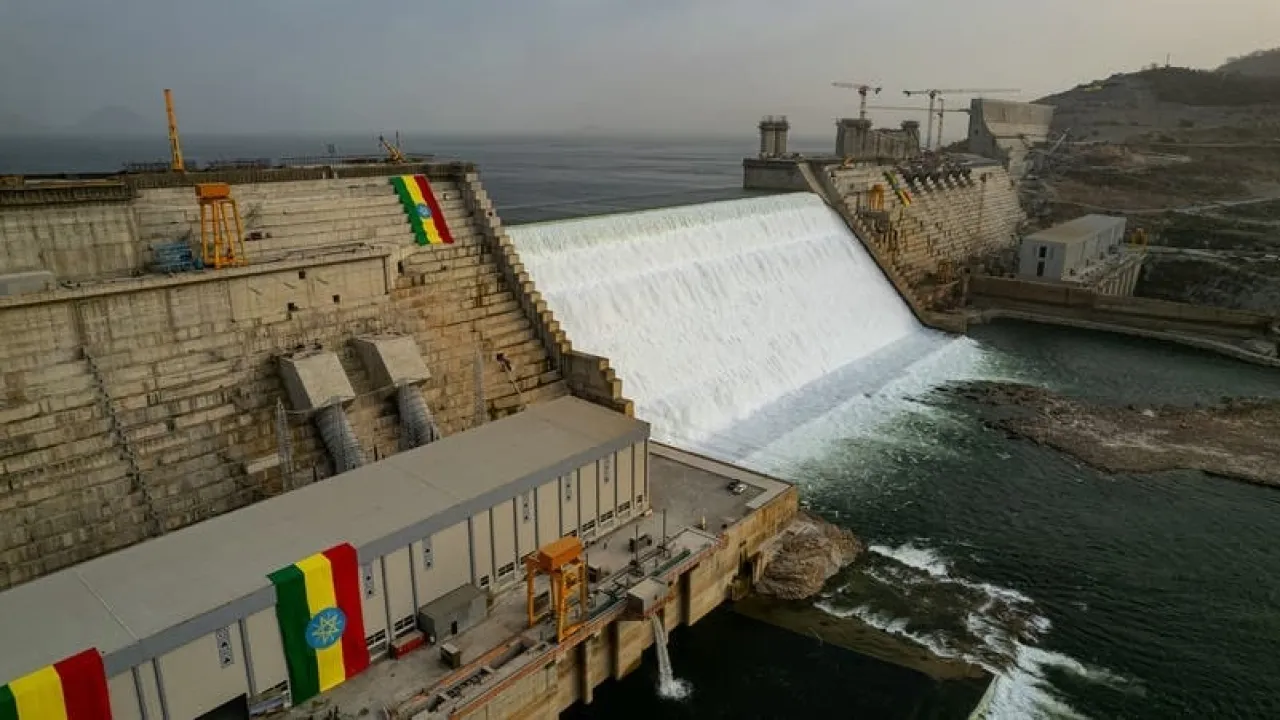
Khaberni - Sudan is experiencing critical and unprecedented moments amid severe concern, with a record rise in Nile River levels. These conditions compelled the Sudanese Ministry of Irrigation to issue a "red alert" along the Nile strip, in anticipation of potential floods.
Experts warned that continued discharge from the Renaissance Dam above normal levels could double the risks, threatening Sudan with inundation.
The crisis raises questions about its potential impact on Egypt, and whether it too might face flooding due to the abnormal discharge from the Ethiopian dam.
Dr. Nader Nour El-Din, a professor of water resources at Cairo University, told "Alarabiya.net" and "Alhadath.net" that what Sudan has recently experienced does not surpass declaring a state of maximum readiness, in anticipation of a possible flood, as Nile levels approach the danger threshold.
He clarified that the level is still a full meter below that of a major flood, which means that the situation has not yet reached the stage of inundation as some suggest.
He added that some voices exaggerate in describing the situation by saying that Sudan has sunk, while scientific facts prove otherwise.
He noted that the High Dam in Egypt is capable of protecting the country with a massive storage capacity of 162 billion cubic meters, in addition to the three side lakes around Lake Nasser with an additional capacity of 22 billion cubic meters, and the Toshka spillway capable of discharging more than 20 billion cubic meters.
Nour El-Din emphasized that even in the hypothetical scenario of the complete draining of the Ethiopian dam's lake, Egypt would not be affected, due to the High Dam system's capacity to absorb this volume.
He explained that Egypt withdraws about 55 billion cubic meters from the lake's stock before the start of the flood season, which is its annual consumption, providing additional capacity to accommodate any new amounts of water without danger.
Meanwhile, Dr. Abbas Sharaqi, a professor of water resources and geology at Cairo University, told "Alarabiya.net" and "Alhadath.net," that the flood crisis witnessed by Sudan is directly linked to the Ethiopian Renaissance Dam.
He explained that after the completion of the filling last year, the turbines were not operated as announced, where it was supposed to have 13 turbines in operation, but only 4 went into service then stopped.
Sharaqi added that Ethiopia did not perform a gradual discharge process to accommodate the rainy season's waters, but rather persisted in denial to avoid revealing the turbines' malfunction.
With the arrival of the rainy season last July, the dam's lake filled until the waters overflowed from the top, causing approximately 750 million cubic meters to flow daily towards Sudan.