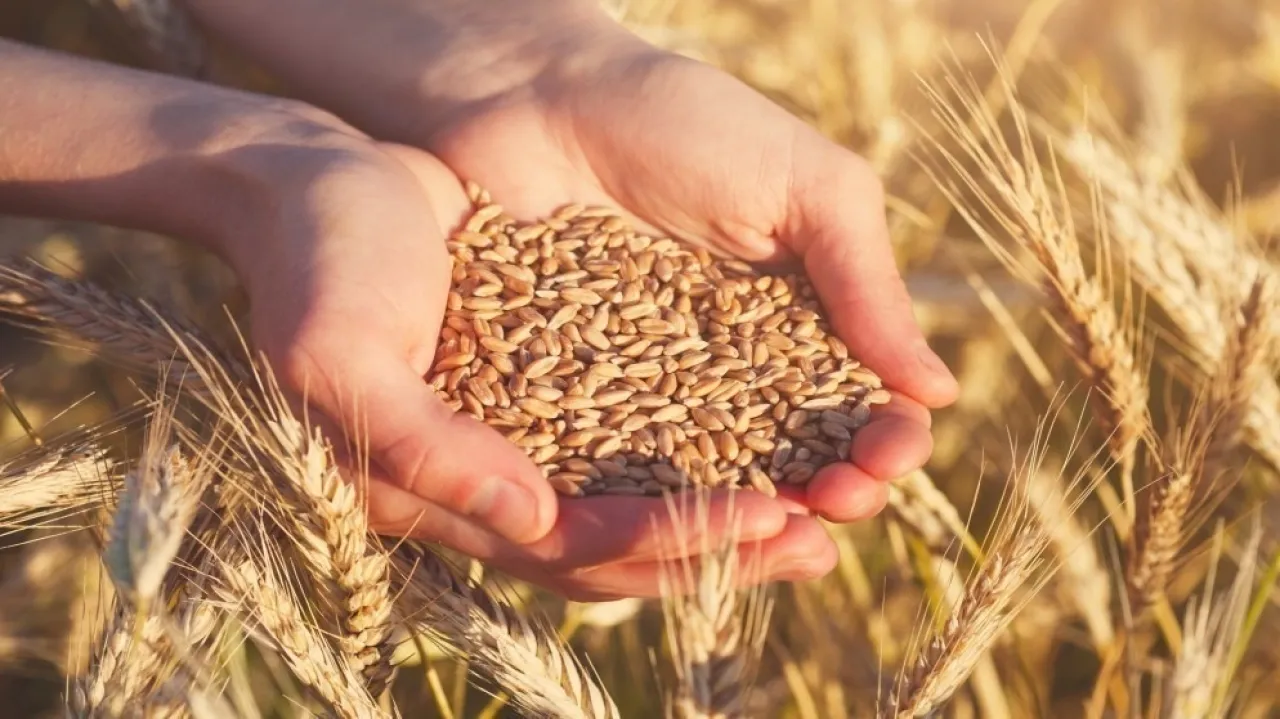
Khaberni -The Secretary-General of the Ministry of Agriculture, Mohammad Al-Hiyari, announced that the ministry continues to implement the project of receiving and purchasing local grains from wheat and barley crops for the agricultural season 2024/2025, where the receipt operations began in various regions starting Sunday and will continue until August 7, 2025, through specialized committees affiliated with the Central Committee for Purchasing Local Grains.
Al-Hiyari explained that the quantities expected to be received this season are estimated at about 36,000 tons of wheat and barley, out of approximately 76,000 dunums planted in the three regions, expecting to issue about 424 certificates of origin (production) to farmers.
He indicated that the committees supervising the implementation of this project include representatives from several official entities comprising: the Ministry of Agriculture, the Ministry of Industry, Trade and Supply, the Ministry of Finance, the Audit Bureau, the Jordanian Cooperative Corporation, and the National Center for Agricultural Research, noting that these committees include purchasing, receiving, inspection, auditing, field inspection, and certificate verification committees.
Regarding the prices, Al-Hiyari mentioned that the purchase price of wheat seeds for the current season is 500 dinars per ton, and barley seeds 420 dinars, however, a discount of 50 dinars per ton was adopted, making wheat seeds sold to farmers at a price of 450 dinars per ton, and barley seeds at 370 dinars.
As for the purchase price of food grains for this season, it has been set at 420 dinars per ton for wheat, and 370 dinars per ton for barley.
He pointed out that the public treasury bears the cost of screening and sterilization, amounting to 75 dinars per ton, while the Jordanian Cooperative Corporation bears the cost of screening residues and packaging the seeds at a rate of 25 dinars per ton, in addition to the announced reduction in seed prices.
Al-Hiyari emphasized the necessity of adherence to production certificates and crop quantities according to the planted areas, based on reports from field inspection committees, allowing for a surplus of up to 15% of the specified quantity.
Regarding delivery centers, he explained that farmers in the northern region deliver grains to the Irbid silos, central region farmers to the Juwaideh silos in Amman, and southern region farmers to the reception center in Al-Rabba in Karak Governorate, where the treasury assumes the cost of transporting grains from the south to the Juwaideh silos.
Al-Hiyari concluded his talk by pointing out that the ministry has adopted an electronic platform this year for issuing production certificates, enabling farmers to submit their applications and complete all issuance procedures electronically, as part of the ministry's efforts in digital transformation and simplifying procedures.