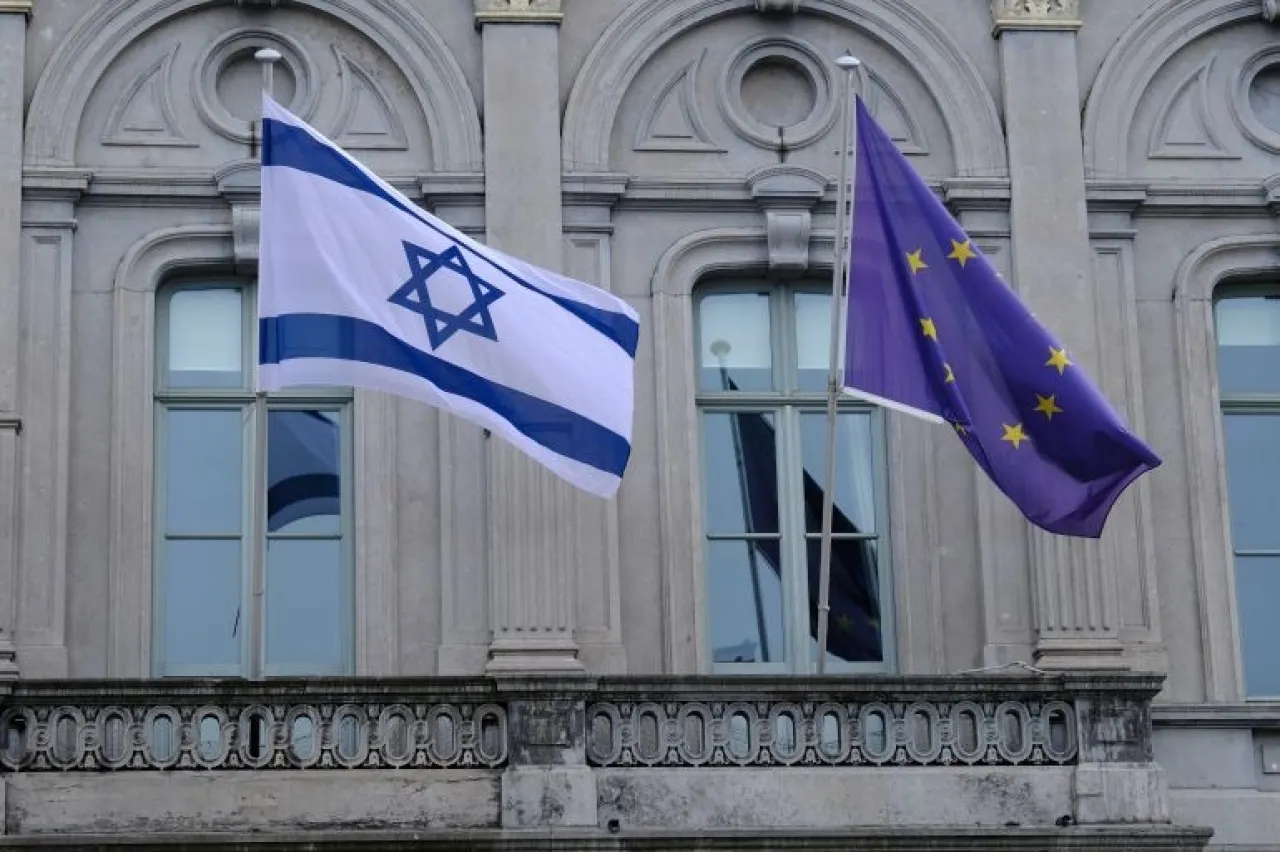
Khaberni -Trade tensions between Israel and Europe are escalating unprecedentedly amid the ongoing war on Gaza and its worsening humanitarian repercussions. Both Britain and the European Union are exploring steps that could lead to the freezing or cancellation of existing trade agreements with Israel, a development that threatens economic consequences and potential losses estimated in the tens of billions of dollars.
In a notable development, the British Foreign Office announced the suspension of negotiations on a new free trade agreement with Israel, explicitly mentioning the government of Benjamin Netanyahu, in a stance that reflects clear political dimensions transcending economic aspects.
The British decision comes at a sensitive time, as the agreement represented for Israel an opportunity to bolster its trade relations with one of the world's leading powers, especially after Britain's exit from the European Union. On a broader European level, the European Union's Commissioner for Foreign Affairs announced that the bloc would discuss the future of the trade agreement with Israel.
While this direction has caused concern in political and economic circles within Israel, any substantial modification of the existing agreement with the European Union would require the consensus of all 27 member states, noting that only 17 countries have so far expressed their support for revisiting the agreement, thus reducing the prospects for immediate change, but reflecting a gradual shift in European attitudes towards Israel.
International Pressure and Internal Warnings
These developments come amid increasing international pressure on Israel, especially after the faltering negotiations for a prisoner exchange deal due to the hardline stance of Netanyahu's government. Within Israel, calls are mounting for a comprehensive review of the military and political course in Gaza, amid warnings of declining international support and diminishing effectiveness of military operations.
Britain is among Israel's important trading partners. In 2024, Israel's exports to Britain (excluding diamonds) amounted to approximately $1.28 billion, compared to $1.8 billion in 2023, according to the economic newspaper "Globes." Chemicals and pharmaceuticals account for about a third of these exports, which are vital sectors for the Israeli economy.
In contrast, Israel imports goods worth about $2.5 billion from Britain, meaning the United Kingdom achieves a trade surplus of $1.3 billion in its favor.
As for the European Union, it is Israel's largest trading partner after the United States. In 2024, Israel's exports to the Union amounted to approximately 15.9 billion euros, compared to European imports of about 26.7 billion euros, dominated by chemicals and machinery.
Potential Hefty Price
Economic experts warn that the ongoing war in Gaza could cost Israel a hefty economic price. Analysts believe that the trade agreement with Britain, which was seen as a strategic achievement, could turn into a symbol of political and economic failure, especially with increasing talk of a potential boycott threatening about 13.5% of Israel's gross domestic product.
Locally, there is an increasing call for new political proposals to end the war and avoid serious consequences for the economy and Israel's international stature.
Expanding Boycott
According to Adrian Bailout, the chief economic analyst at the Israeli newspaper "Calcalist," these developments are not limited to the political dimension but also hint at an "economic price exceeding $76 billion," with a risk of eroding up to 13.5% of the gross domestic product.
He adds that the free trade agreement with Britain, which was expected to become a model, now faces the risk of suspension or cancellation, emphasizing that the military escalation in Gaza, along with some European countries' accusations of "violating international humanitarian law," have prompted Western partners to reassess their economic relations with Israel.
Bailout believes that trade agreements, which were fundamental pillars of the Israeli economy, have turned into tools of pressure in the hands of Europeans, amidst a crisis that is expanding day by day. He refers to the current path of the Israeli government coupled with rising international isolation, placing the country before a serious challenge that could affect not just the institutions but the entire Israeli society.
Investor Confidence Decline
Meanwhile, Eitan Avriel, editor-in-chief of "The Marker" newspaper, sees that continuing current policies towards Gaza may lead to Israeli financial assets losing their market value. He adds that increasing accusations against Israel of "committing moral and political violations" undermine investor confidence. He points out that the Norwegian Sovereign Wealth Fund has already begun selling its investments in Israeli companies.
He notes that the ethical and economic debate about the war in Gaza is almost absent domestically, while its repercussions are beginning to appear externally, with Norwegian, Irish, and Japanese movements reducing investments, while the European Union considers canceling the trade agreement, and Britain suspends updating the agreement and summons the Israeli ambassador.
Avriel concludes that these movements indicate growing economic isolation, and markets may begin to price this isolation through discounts on Israeli stocks and higher returns on bonds, which will negatively reflect on the economy.
He warns that a South African scenario during the apartheid regime may not be far off if current policies continue, pointing to potential sharp declines in currency value, discounts exceeding 30%, and a clear message to investors that investing in a state accused of war crimes may turn into a major risk.